The strategy deck is excellent. Genuinely. Coherent narrative. Clear priorities. Confident presentation.
And then someone asks the question that changes the room.
Who owns this? What does success look like in ninety days? What number moves if this works?
Silence. Or a name that turns out to be a team. Or a metric that turns out to be an activity.
In the video below, Simon explains why a plan without owners or numbers is one of the quietest, and most damaging, patterns he encounters across the B2B boards he sits on.
A great plan is not the same as an accountable one
The problem isn’t the quality of thinking. In most scaling businesses the strategy is genuinely coherent. The issue is what happens, or doesn’t happen, when you try to connect that strategy to the people and numbers that are supposed to deliver it.
What Simon finds in almost every board pack he reviews:
Job specs that describe tasks rather than owned outcomes. Marketing plans that cover channels with no MQL contribution model attached. Cost savings forecast without a mechanism to deliver them. AI efficiency gains baked into budgets with no evidence base and no named owner.
The result is a board that can have an intelligent discussion about direction – and still be completely unable to hold anyone accountable for anything.
Because accountability requires two things: a number and a name. And most plans have neither.
Where this breaks down in scaling businesses
This pattern is particularly common in businesses that have grown fast and haven’t had the chance for systems to catch up with commercial reality.
The culture that got a business to where it is – collaborative, generalist, founder-led – starts to strain as headcount grows. Internal engagement scores quietly deteriorate. Founders find themselves answering questions that should belong to their team leads. Decisions that should be distributed upward are centralised instead.
The underlying cause is almost always the same: roles have been defined by activity rather than accountability.
When a role is built around what someone does, it creates dependency on the founder to interpret whether it’s working. When a role is built around what someone owns – a number, an outcome, a measurable commitment – the team can operate with genuine autonomy and the business can scale without the founder becoming the bottleneck.
The shift that changes everything
The transition from an activity-based culture to a performance culture isn’t a restructure. It’s a design decision.
It starts with moving from generalist to specialist roles – giving people clear lanes as the business grows, rather than asking everyone to cover everything. It continues with building an OKR or KPI framework that is explicit about ownership: not just what needs to happen, but whose job it is to make it happen and how success will be measured.
And it ends with a different kind of leadership conversation. Instead of the founder answering every question, the model shifts to: here is what needs to be achieved, it is your job to decide how, and my role is to challenge and coach you through it.
That is the difference between a startup culture and a performance culture. Both have their place. But only one of them scales.
What board-ready accountability design looks like
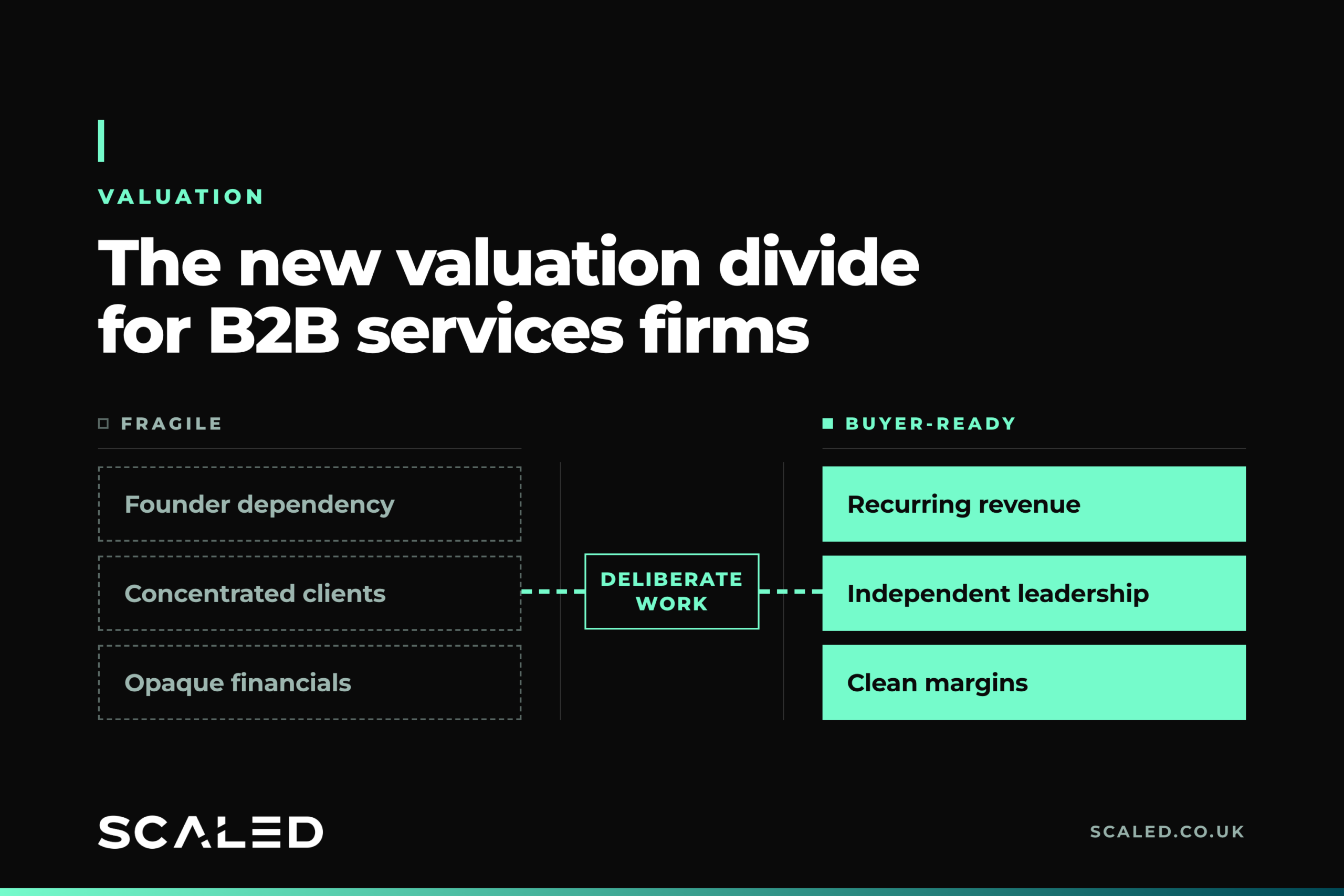
For founders thinking about governance, investor readiness or exit, this isn’t just an operational issue — it’s a valuation one.
Buyers and investors looking at a scaling B2B business will probe quickly for whether growth is dependent on the founder or distributed across the leadership team. A business where every answer flows back to one person carries a concentration risk that will be priced in.
The fix isn’t a performance management exercise. It’s a clarity exercise. For each strategic priority in the plan:
Name – one person, not a team, who owns the outcome.
Number – a measurable commitment that defines what success looks like in a defined timeframe.
Narrative – a short explanation of the mechanism: how this person will move that number, and what they’ll need to do it.
When those three things exist for every item in a plan, the board can govern rather than just observe. And the business has the foundation for the kind of accountable leadership structure that holds its value under scrutiny.
The diagnostic question
If a founder asked every direct report to name the one number they personally own and are accountable for, and nobody could answer in under ten seconds, that’s the signal.
Not that the strategy is wrong. That it hasn’t been connected to the people and commitments that will deliver it.
That connection is what separates businesses that scale from businesses that stall.
Scaled works with a select number of service-led and digitally-enabled businesses to accelerate growth and build enterprise value. Get in touch to find out if we can help.