Scaled founder Simon Penson has spent two decades building, scaling and investing in B2B businesses – first as an agency founder who sold to IPG, and since as an investor, Chair and NED across more than a hundred companies through Haatch. Here, he explains why so few founders can answer a question that matters more than almost any other, and what a proper health score actually reveals.
Ask a hundred B2B founders what their business is worth and you will get a hundred different kinds of answer. A handful will quote a multiple they heard somewhere and hope it sticks. A few will point to last year’s EBITDA and shrug. Most, if they are honest, will simply say they don’t know.
I have sat across the table from founders in exactly this position more times than I can count, first as an agency owner building towards my own exit, and for the decade since as an investor, Chair and NED inside more than a hundred businesses through Haatch. The pattern never changes. Brilliant operators, real businesses, and almost no honest, current view of how healthy the thing they have built actually is, or what would move the number if they knew where to look.
That is not a failure of intelligence. It is a failure of access. The tools that assess a business properly, the way a buyer or an investor would, have always sat behind expensive advisors, formal deal processes and reports that were stale within a quarter of landing. By the time most founders get a genuine read on their business, a process is usually already underway, and the window to change anything meaningful has narrowed to almost nothing.
A business health score exists to close that gap. Here is what one actually measures, why revenue is a poor substitute for it, and why the founders who exit well are almost always the ones who started tracking theirs years before they had any intention of selling.
1. It measures what a buyer would assess, not what you track day to day
Most founders run their business by a small handful of numbers: revenue, margin, maybe a headline growth rate. Those numbers matter, but they are not what determines what somebody else would pay for the business, and they are certainly not what a serious buyer’s diligence team spends six weeks picking apart.
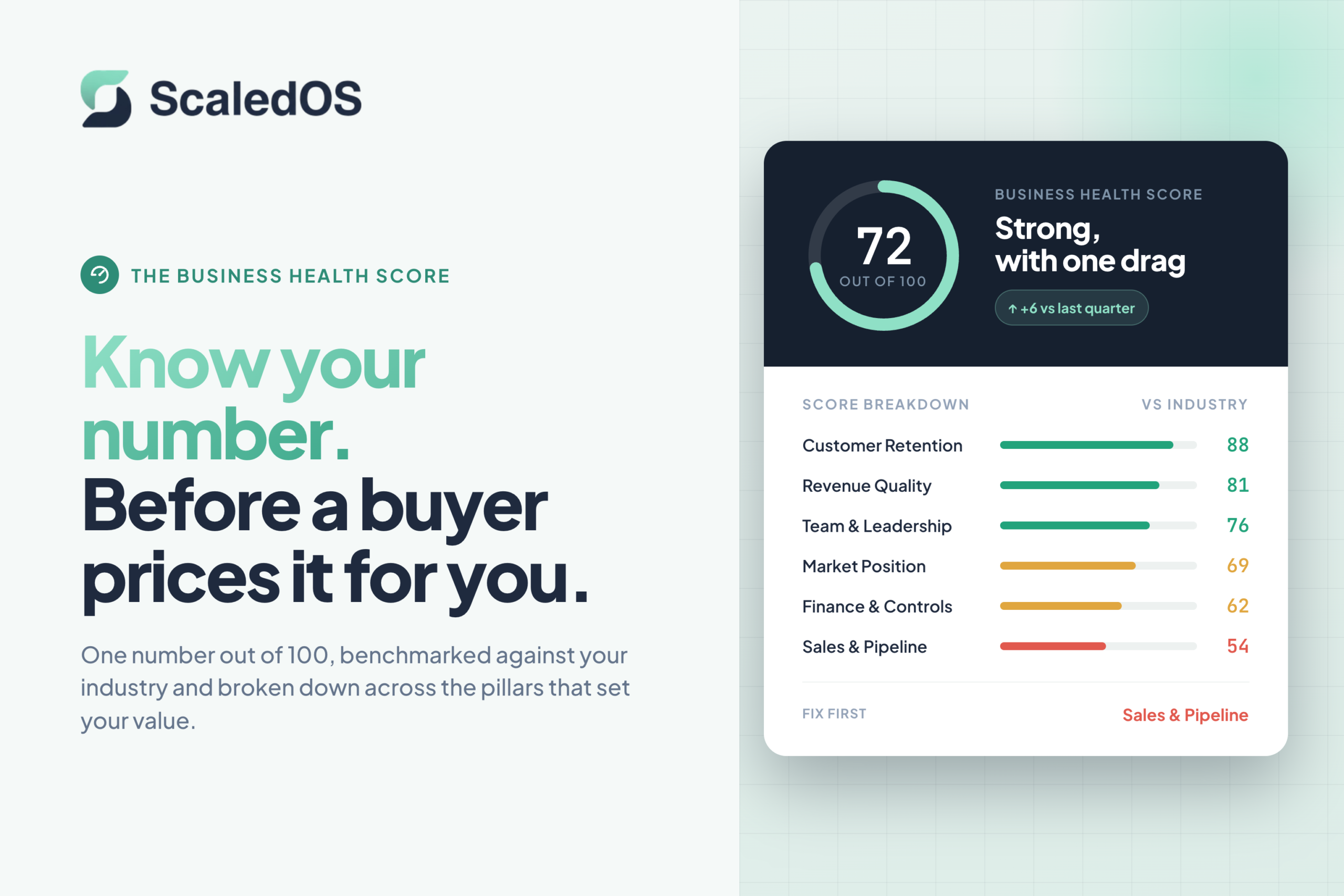
A proper health score looks at the business the way a buyer does, which means it sits across three broad areas. Strategic health, covering your positioning, market and the clarity and defensibility of your growth story. Operational health, covering how the business runs without you, the depth of your leadership bench and how consistently you deliver. And financial health, covering the quality of your margin, the predictability of your revenue and how concentrated your risk is across clients. At Scaled we break those three areas down into nine specific domains, because a single blended number tells you very little on its own. A score of seventy that is strong strategically but weak operationally needs a completely different quarter of work than a score of seventy the other way round.
2. Revenue tells you the business works. It does not tell you what it is worth
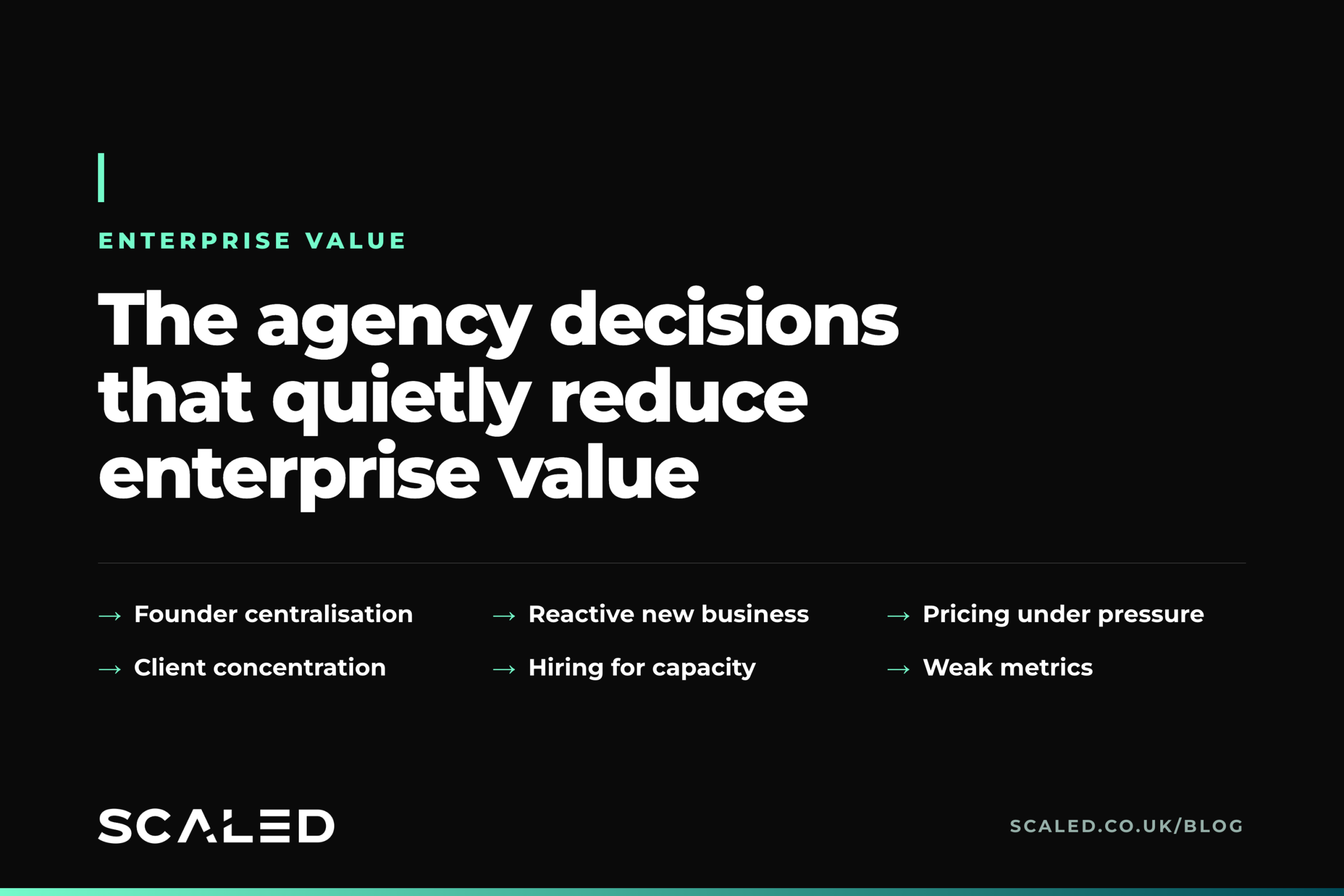
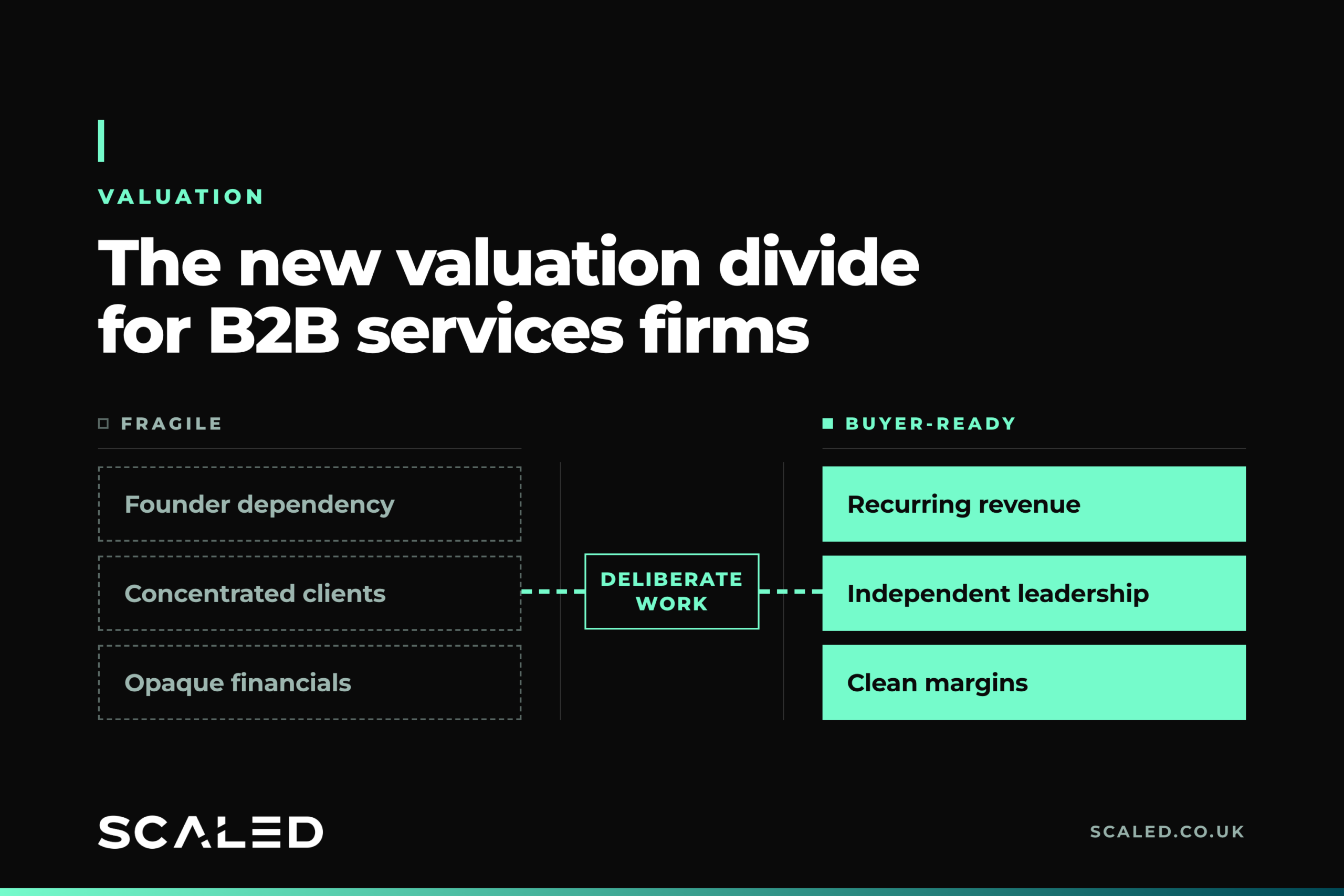
I have watched two businesses billing the same revenue attract wildly different offers, and the reason is never a mystery once you look underneath the top line. One is dependent on its founder for every key relationship, concentrated in two or three clients and running on knowledge that lives in people’s heads rather than in systems. The other has a leadership team that can operate without its founder, a spread of clients that no single loss would seriously damage, and financials clean enough to survive scrutiny. A buyer will pay a materially higher multiple for the second business, and will often walk away from the first entirely, regardless of how similar the revenue line looks.
This is the gap a health score is built to expose. Revenue tells you the business is working right now. It says nothing about whether that success is repeatable without you, transferable to somebody else, or durable enough to be worth paying a premium for. Founders who only ever look at the top line are, in effect, flying with half the instruments switched off.
See exactly how the scoring works and get your first number →
3. A score you check once is a snapshot. A score you track is a strategy
Here is where most founders make their most expensive mistake, and it is rarely their fault. The natural moment to ask what your business is worth is when you start thinking about selling it, which means the natural moment to find out is usually eighteen months to two years too late to do very much about it. You cannot rebuild a leadership bench, diversify a concentrated client base or clean up years of messy revenue recognition in the six weeks before a buyer’s advisors start asking difficult questions.
Value is built or lost in the years before a deal, never in the weeks during one. Which means a health score checked once, however accurate, is only mildly useful. A health score tracked over quarters is something closer to a strategy, because it shows you which domain is drifting while the problem is still small enough to fix cheaply, rather than large enough to cost you a full turn of multiple once somebody else finally points it out.
Knowing your number, properly
Historically, getting any of this meant commissioning advisory work, sitting through workshops and paying a serious fee for a report that was already ageing by the time it landed on your desk. That barrier is exactly what we built ScaledOS to remove.
At the centre of it sits the Business MOT, a scored diagnostic that assesses a business across those nine domains the way a serious buyer would, then sequences what is holding it back so a founder knows what to fix first rather than facing a generic checklist. Alongside it, an Enterprise Value Tool gives a live, directional read on what the business is worth today, and Financial Benchmarking shows how its margins, growth and revenue quality compare to businesses at a similar stage and in the same sector. It takes minutes rather than months, and because it comes back to you every quarter, you get the trend rather than a single snapshot.
Every founder building towards something bigger, whether that is a sale in three years or simply a business that no longer depends entirely on them, should know their number. Not because the score itself is the goal, but because nobody has ever improved something they could not first see clearly.