There is a pattern that shows up in board meetings more often than most founders would like to admit.
The business has a brilliant month. Then another. Revenue is up, the team is confident, and the mood in the room is good. And then, seemingly out of nowhere, the same business is back in crisis mode – scrambling, anxious, firefighting.
It looks like volatility. It’s usually something more structural.
In the short video below, Scaled founder Simon Penson — drawing on patterns observed across dozens of board meetings of growing agencies, B2B service businesses and SaaS companies — explains what that boom-and-bust cycle is really signalling, and what to do about it.
The problem isn’t the bad month. It’s the concentration.
When a business swings repeatedly between strong performance and crisis, the instinct is to treat each downturn as an isolated event. A client left. A project slipped. A big invoice came in late.
But when it keeps happening, it’s rarely bad luck. It’s almost always client concentration.
If a handful of clients, often just three to five, account for the majority of revenue, then the business is only ever one conversation away from a crisis. A single client leaving doesn’t dent the numbers; it detonates them. And because clients and customers always leave eventually, that day will come. The only question is when.
This is one of the clearest indicators of fragility a board can look at. It’s also one of the first things any serious buyer will interrogate.
Concentration rarely travels alone
The reason concentration is so dangerous is that it almost never exists in isolation.
It tends to sit alongside a thin pipeline and an underdeveloped sales and marketing engine. And that combination is what turns a manageable risk into a permanent state of jeopardy.
When you have three to five clients that genuinely matter, no systematic way of replacing any of them, and pipeline coverage that isn’t sufficient to absorb a loss, you are (by design) flying from crisis to crisis. Every strong month is borrowed time, because nothing underneath it is building the resilience to survive a departure.
The fix is a proper demand engine
If you recognise your business in this, building a genuine demand generation and new business engine becomes the absolute number one priority. Not a nice-to-have. The priority.
A real engine does two things at once. It dilutes concentration over time, spreading revenue across a broader base so that no single client can hold the business hostage. And it provides the fallback — the replacement pipeline that catches you if the worst does happen and a key client walks.
The key word is systematic. Relying on referral and recommendation isn’t a demand engine; it’s hope with a good track record. It works right up until the month it doesn’t. A proper engine is built, resourced and repeatable, so that new business arrives by design rather than by luck.
Why this matters beyond the board meeting
Client concentration is uncomfortable in a board meeting. But its real cost shows up later, and larger.
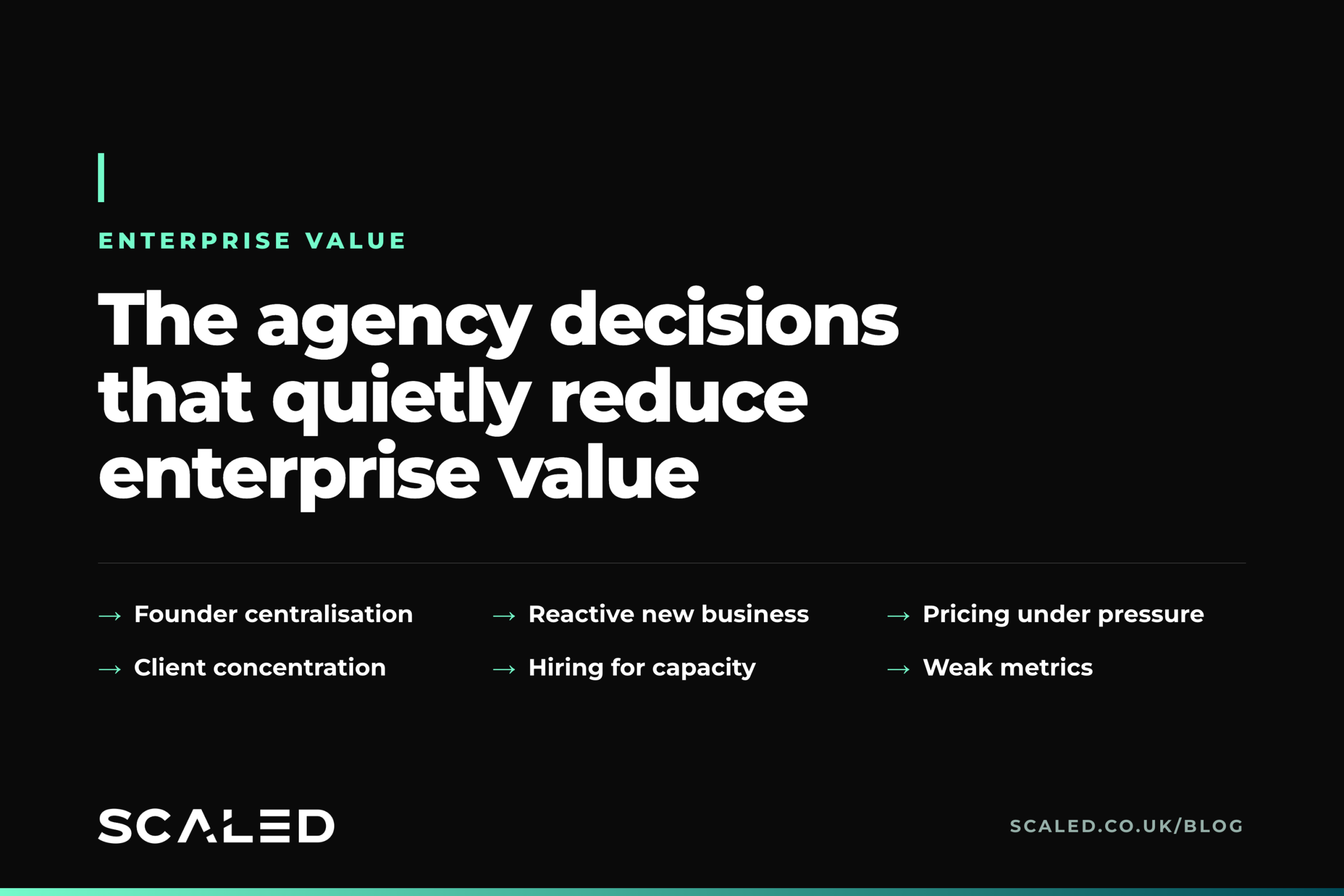
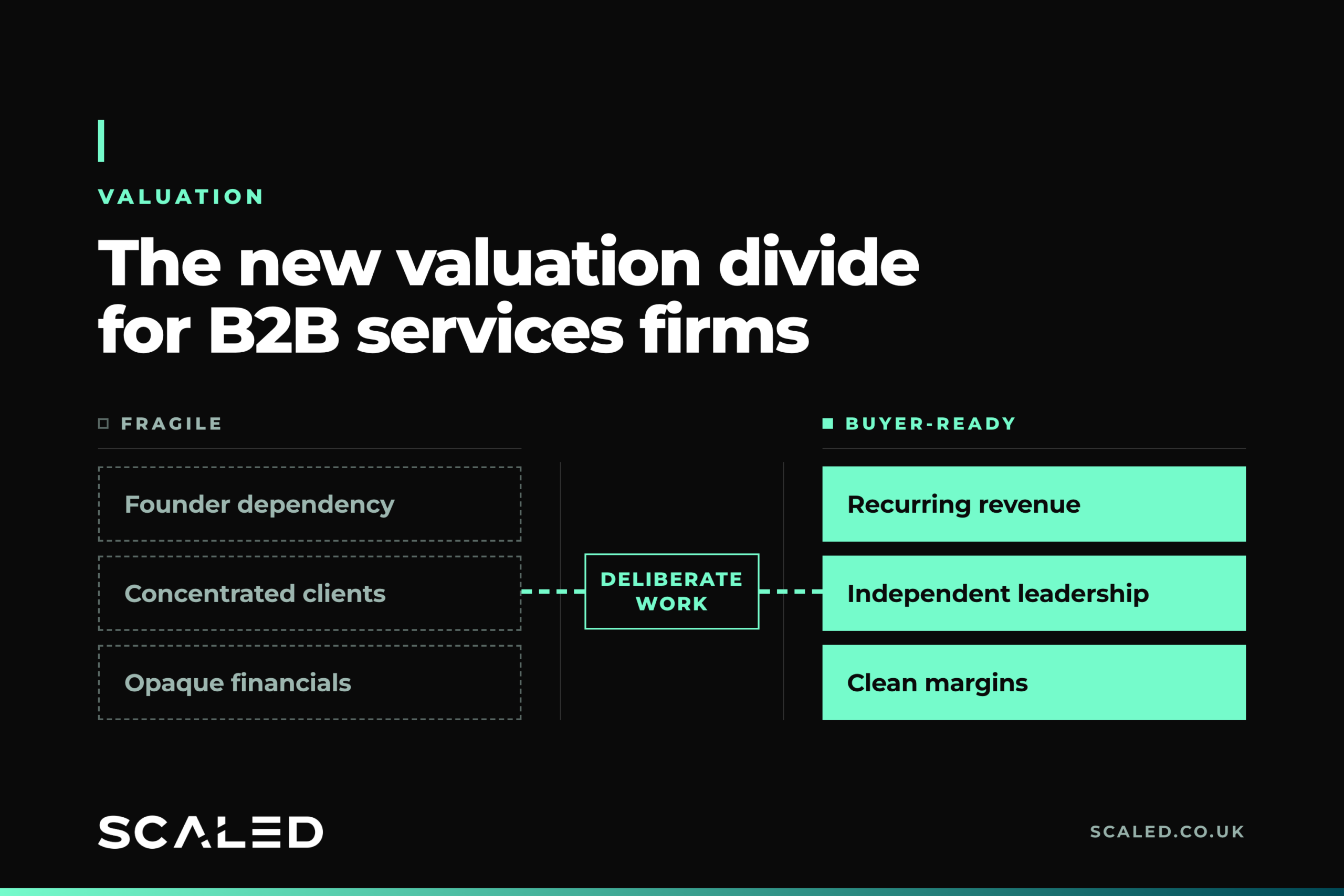
For any founder thinking about scale, investment or eventual exit, concentration is one of the most heavily scrutinised risks there is. Buyers will always look for it, because it tells them exactly how exposed the business would be under their ownership. High concentration, a thin pipeline and a weak commercial engine are read as a single signal: this business hasn’t built the machinery to sustain itself. And that perceived risk is paid for directly, in a lower multiple.
Reducing concentration isn’t just about sleeping better at night, though it does that too. It’s about building enterprise value.
The diagnostic question to ask
If your business keeps cycling between strong months and sudden crises, the question isn’t how to handle the next downturn. It’s this: if your largest client left tomorrow, do you have a systematic way of replacing them — and is your pipeline coverage genuinely sufficient to survive it?
If the honest answer is no, that’s where to start.