TL;DR
- £2m to £3m is where most B2B businesses hit a structural wall, not a capability one.
- The root cause is founder dependency: the business has grown, but decision-making hasn’t been distributed.
- Working harder won’t fix it, but these will:
- Hire for judgement, not tasks
- Systemise the decisions that live in your head
- Get clear on what you actually want
- Both paths, scale or exit, require the same underlying work. The difference is the focus.
- The complexity gap won’t close itself. And someone lower down the org chart won’t close it.
We see the same pattern in rapidly growing B2B businesses, and it happens with striking consistency when revenue lands between £2 million and £3 million.
The business is going well. Clients are happy. Headcount has grown from a handful to 20, 30, or more. And yet the founder is still in every pitch, every hiring decision, every awkward client call. Still approving things that should never have needed their approval.
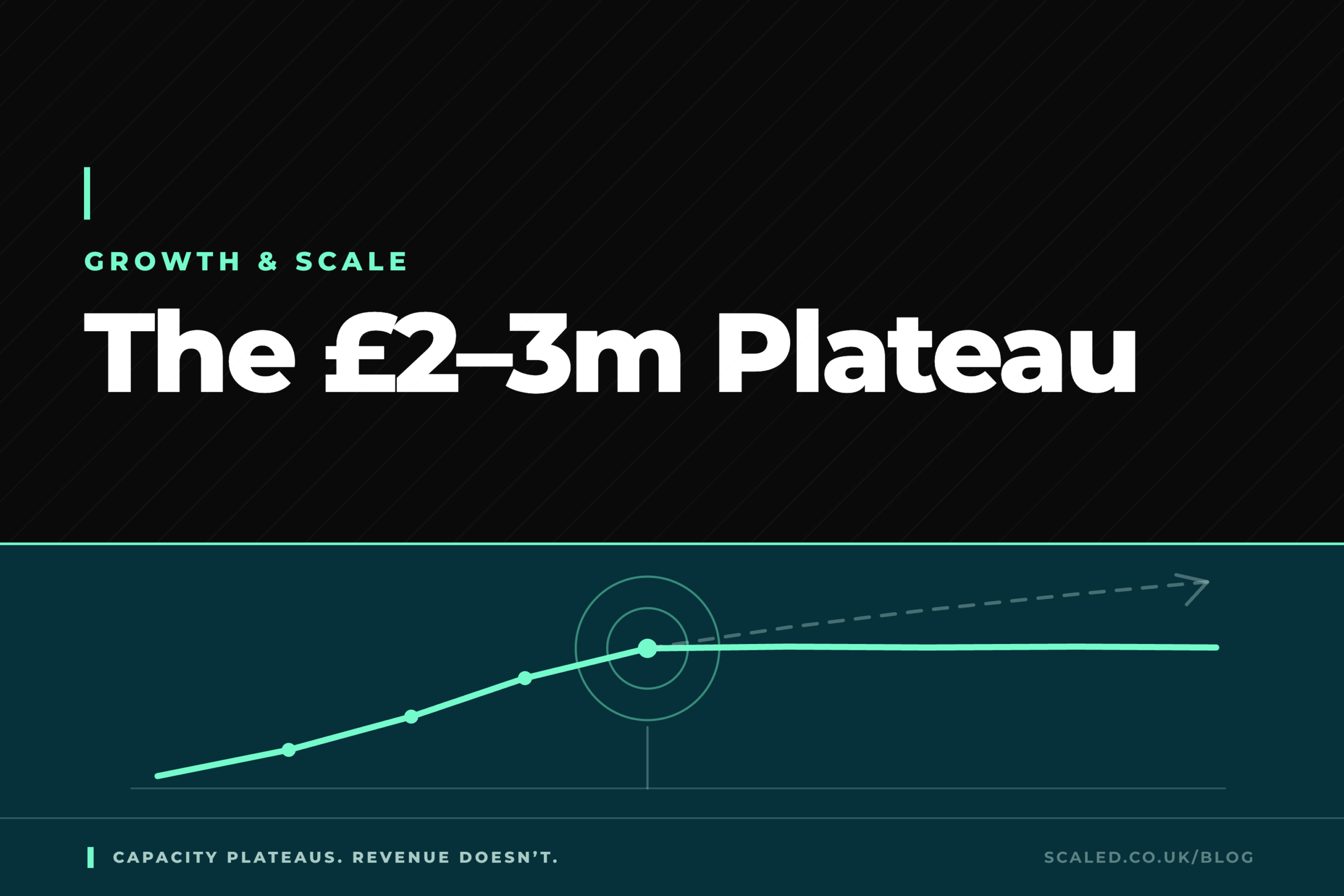
This is the complexity gap. It is one of the PRIMARY reasons growth stalls at this stage. And it is almost entirely STRUCTURAL. Not a reflection of capability, effort, or ambition.
We know, because we’ve sat in that seat ourselves.
Why It Happens at This Exact Point
Under £1m, a founder can hold the entire business in their head. There aren’t enough people, customers, or decisions to make that difficult. Inefficient, yes. But manageable, because the volume is low enough for one person’s judgement to carry everything.
Past £2m, that stops being true.
Most businesses at this stage have two or three layers of staff:
- Delivery
- Sales
- Some operational function
But none of those people was hired to replace the founder’s judgement. They were hired to handle the tasks the founder didn’t have time to do. The work gets distributed. The decision-making doesn’t.
Every significant call: who gets promoted, which client gets the discount, whether the new hire is worth the risk. All of it still routes back to one person.
This isn’t a people problem. It’s a STRUCTURAL one. The business has grown in size, but founder bandwidth hasn’t, and it never will. That capacity plateaus while revenue keeps climbing.
What makes this stage particularly damaging is that the cracks don’t just show in the diary. They show in the numbers:
- Margins soften because senior people are spending time on work that shouldn’t need them.
- Growth slows because the founder is the bottleneck on every new client and every new hire.
- EV takes a hit because revenue that doesn’t survive the founder stepping back isn’t enterprise value. It’s a well-paid job.
That last point is the one buyers find fastest in due diligence. We’ve seen it kill deals at the most unfortunate moment.
The Three Shifts That Actually Move the Needle
Working harder won’t fix this. We know you don’t want to hear that. But it’s true.
The businesses we work with that DO break through differ in three ways. None of them is about effort.
1. Stop Hiring for Tasks. Hire for Judgement.
Most hiring at this stage is reactive. The business needs more capacity, so it adds more hands. That only spreads the workload. It doesn’t touch the bottleneck.
Real change comes from hiring a senior operator who can make the kinds of decisions the founder used to make: pricing exceptions, delivery trade-offs, people calls. This is a different type of hire, at a higher level. It almost always costs more than founders expect. It’s also almost always cheaper than the alternative. The founder continuing to cap growth is the most expensive thing in the business.
How to identify the hire: look at the last ten decisions made personally this month. How many genuinely required the founder, versus how many just required someone with the judgement to decide and the authority to own the outcome? The gap between those two numbers is the job description for the next hire.
2. Put a System Where Instinct Used to Live.
This isn’t about bureaucracy. Founders who’ve been burned by corporate process are usually allergic to that word, and rightly so. This is NARROWER than that.
It’s about making sure the handful of decisions that happen constantly: how a client complaint gets escalated, what triggers a pricing conversation, how a delivery risk is flagged. Right now, all of those pass through one person’s head because they’re the only one who knows what “normal” looks like.
Written down, a decision like that becomes something a senior hire can execute against. Left in the founder’s head, it stays a permanent dependency.
Where to start: pick the three decisions that come up most often. Write down exactly how each one gets made. That document starts the system. As a rule, it takes an afternoon, not a quarter.
3. Be Honest About What You Actually Want.
This is the piece founders most often skip. And it matters MOST.
Some founders genuinely want to keep building: bigger teams, bigger ambitions, a significantly larger exit. Others have quietly realised they want their life back. Less always-on pressure. More breathing room. A business that runs whether or not they’re in the room. Both are valid. What isn’t valid, if the goal is to move past this plateau, is refusing to decide.
The plateau penalises indecision, because the two paths require different actions:
- Building for scale: invest in leadership and systems before the revenue justifies it. The spend comes first. The return follows.
- Building for a cleaner exit: the same systems apply, but with a sharper focus on removing founder dependency rather than adding capability beneath it. Our Exit & M&A Advisory work starts exactly here.
What to do: answer it plainly, on paper, not in your head. If that answer isn’t clear yet, that’s usually why nothing else has moved.
The Bottom Line
None of this comes from working harder. Founders at this stage are usually already working too hard. That’s often THE real problem.
It comes from working differently. From handing direct control of the areas you’re good at to people who may do them differently, so you can focus on the few decisions only you can make.
Founders who get through this stage usually admit they got there later than they’d have liked. That’s fine. Those who never do stay exactly where they are, at this revenue level, indefinitely.
The complexity gap won’t close itself. Someone has to close it. And it won’t be someone lower down the org chart.
If you want to understand what a structured exit actually looks like, start with our Exit Blueprint.
Is your business still dependent on you for every major decision, or is it starting to operate without you? Talk to Scaled. No pitch. No BS. Just a clear view of what’s holding the number back.