Key Takeaways
- Enterprise value is built, or eroded, through ordinary operating decisions made years before any sale process starts.
- Founder centralisation is the single most common value leak: if the business cannot function without you, a buyer will price that dependency accordingly.
- Reactive new business, thin or inconsistent margin, and client concentration are structural problems, not just commercial risks.
- Hiring for capacity rather than capability builds a team that cannot grow the business after the founder steps back.
- Adding headcount without improving margin or scalability is complexity, not growth.
- The leaders who build genuinely valuable agencies treat enterprise value as an operating discipline, not an exit project.
- Start this quarter with a written plan: if the strategy lives only in the founder’s head, the business cannot function without them.

Steven Mallon
Partner, Scaled
Most agency founders I work with are driven by the desire to create and realise value. They are focused on growing their business, winning clients, and hiring people. They are busy with lots of areas of focus and responsibility. But when we look under the bonnet together, the same pattern appears: value leaks quietly through decisions that feel entirely reasonable in the moment.
The uncomfortable truth is that enterprise value is not built at the point of sale. It’s either built, or not built, in the day-to-day operating decisions you make years before any buyer ever looks at your business. By the time a due diligence team arrives, the value is either built, or it’s not.
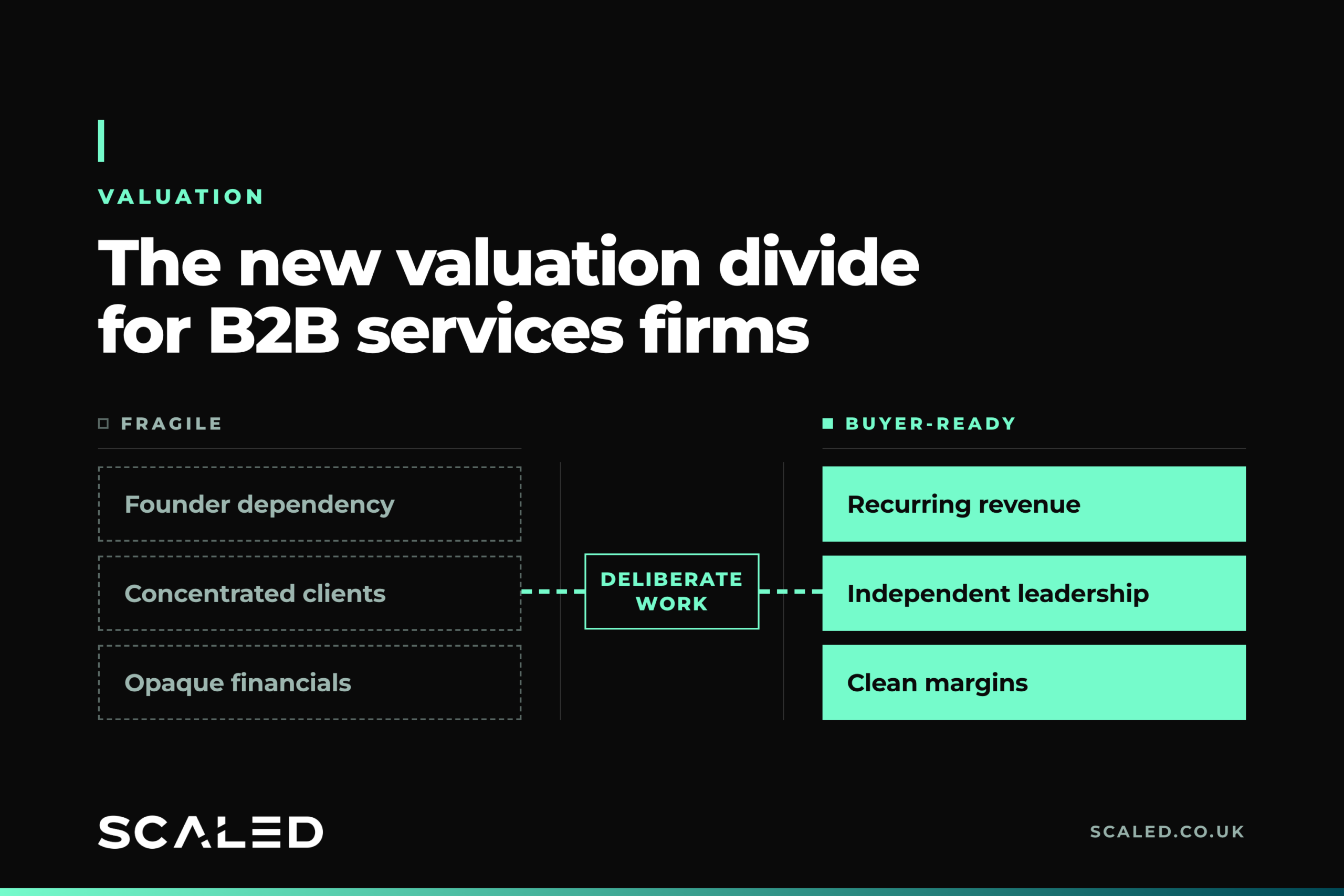
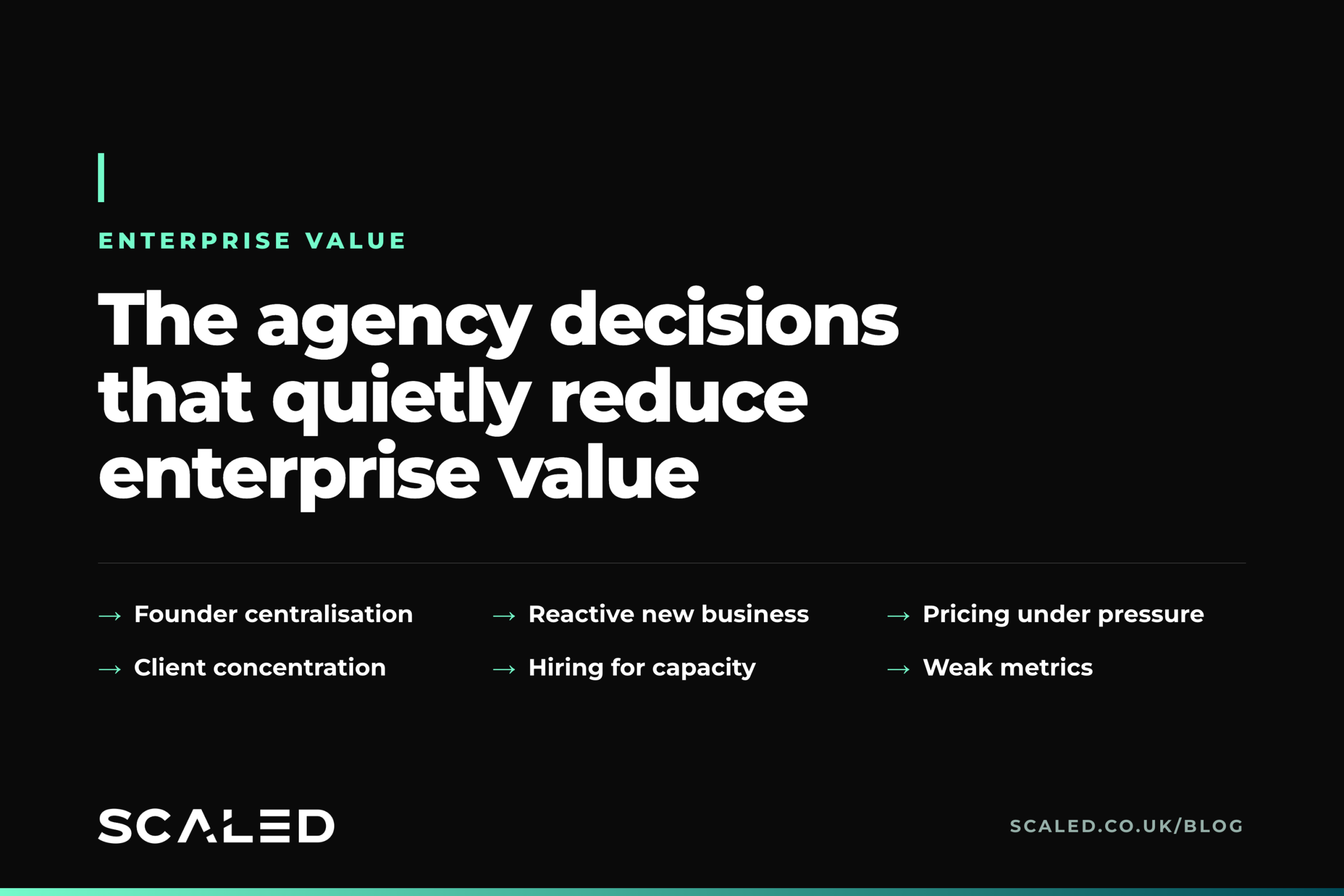
The core argument: The decisions that reduce agency enterprise value are not dramatic mistakes. They are ordinary, well-intentioned choices, founder-led everything, reactive new business, headcount hired for capacity rather than capability, and metrics that measure activity instead of health. Each one looks fine in isolation. Together, they tell a buyer that this business is fragile, founder-dependent, and harder to scale than the revenue line suggests.
This article is about what those decisions are, why they matter to anyone who will ever scrutinise your business, and what you can do about them this quarter.
The Decisions That Leak Value Most
When I sit down with an agency leadership team, I am not looking for catastrophic failures. I am looking for the quiet structural problems that accumulate over time. In my experience, six decisions come up again and again.
Founder centralisation
The most common one is the founder sitting at the centre of everything: client relationships, pitches, key hires, strategic decisions. It feels right because the founder begins and evolves the early stages by leading across all fronts. But a business where the founder is indispensable is a business that a buyer will discount heavily. If you leave, what exactly are they acquiring?
The test is simple: could your business operate, win new clients, and retain key accounts for six months without your active involvement? If the honest answer is no, that is a value problem, not just an operational one.
Reactive new business
Most agencies do not have a new business function. They have a founder who responds to inbound enquiries and referrals, occasionally goes to events, and pitches when asked. That is why I think about founder-led sales as a value issue, not just a sales issue. That is not a sales capability. It is a dependency.
Buyers look for repeatable, scalable revenue processes. Reactive new business signals unpredictable revenue tied to the founder’s network. Both reduce what the business is worth.
This is where I see SCANS, Scaled’s value-based sales methodology for agencies, make a real difference. It is not about closing harder. It is about building a sales process that can run without the founder at the centre of every conversation, and buyers notice.
Pricing decisions made under pressure
Agencies consistently underprice their work not because they don’t know their value, but because they price reactively. A client pushes back. A pitch feels competitive. The founder drops the rate to win the work. Over time, this erodes margin and trains clients to expect discounts.
Margin is one of the clearest signals of operational health. When it is thin or inconsistent, it raises questions about whether the business model actually works at scale.
Client concentration
Having one or two clients represent a large share of revenue is one of the fastest ways to reduce enterprise value. It is not just a commercial risk. It is a structural problem. A buyer sees concentration and immediately asks: what happens if that client leaves? The answer is usually that the business is in serious trouble.
Concentration also creates a dependency dynamic that makes it harder to price properly, push back on scope, or invest in the right capabilities. The big client becomes the business, and the business loses its identity.
Hiring for capacity rather than capability
When agencies grow, they tend to hire to solve the immediate problem: we are busy, we need more hands. The hire is made for today’s workload, not for where the business needs to go. Over time, the team shifts toward delivery capacity rather than strategic capability.
This matters because buyers are not just buying revenue. They are buying a team that can keep growing the business after the founder steps back. A team built for capacity rather than capability does not inspire confidence.
Weak or absent financial and operational metrics
Most agencies I work with do not run their business from a clear set of financial and operational metrics. They know their revenue. They have a rough sense of margin. But metrics like staff cost-to-income ratio and gross profit per head, the ones that actually tell you whether the business model is healthy, are either not tracked or not used to make decisions.
That is where the right framework changes everything. ScaledOS, our enterprise-value operating system for B2B founders, is built around exactly these value drivers. It benchmarks your business against what acquirers actually look at, tracks progress over time, and gives you a prioritised action plan based on the gaps.
Without that visibility, you cannot manage what you cannot measure, and buyers will find the gaps even if you have not.
Why the Leak Starts Years Before a Sale
One of the most damaging myths in the agency world is that you can fix these things when you decide to sell. You cannot. Or rather, you can try, but it will cost you significantly in time, in price, and sometimes in the deal itself.
The reason is simple. Enterprise value reflects the quality of the business as it stands, not as it might be. When a buyer or their advisers look at your business, they look for patterns. How has revenue grown? How consistent is margin? How dependent is the business on one or two people or clients? Those patterns take years to establish, and they take years to change credibly.
A business that starts addressing these issues three years before a sale looks fundamentally different from one that starts three months before. The numbers tell a story. The structure tells a story. The team tells a story. And experienced buyers know how to read all three.
Leaders who build genuinely valuable agencies treat enterprise value as an operating discipline, not an exit project. They are asking the right questions about their business years before they need to.
How Most Agency Leaders Find Out There Is a Problem
In my experience, agency leaders find out about these value gaps in one of three ways, and none of them is comfortable.
The first is a sale that does not go as expected. The founder has a number in their head, built up over years of hard work and growth. The buyer’s offer, or the due diligence findings, tell a very different story. By then, the options are limited.
The second is a growth ceiling. The business reaches a point where it cannot grow without the founder doing more, and the founder is already at capacity. Structural problems manageable at one size become impossible at the next.
The third, and the one I see most often in my work, is a planning conversation that forces the question. Someone, a board adviser, an NED, a trusted peer, asks: if you had to sell this business today, what would a buyer actually see? That question, asked honestly, tends to surface everything.
The good news is that the third route is available to any founder who chooses it. You do not have to wait for a sale process or a growth ceiling to find out where the gaps are.
A Real Example: When Growth Masks the Problem
I worked with an agency that, by most measures, was doing well. Revenue was growing. The team was expanding. The path to value looked strong, and the founder’s ambition seemed to be being met.
But when we looked at the business properly, a different picture emerged. The founder handled every significant client relationship. New business came almost entirely through their personal network. Two clients accounted for most of the revenue. The team was strong on delivery but had no one who could credibly lead client development on their own.
The business was growing, but it was not becoming more valuable. It was becoming more dependent.
We worked together on a planning process that addressed each of those issues in sequence: building a leadership layer that could own client relationships, putting a structured new business approach in place, and actively diversifying the client base. None of it was quick. But within a couple of years, the business looked fundamentally different to anyone assessing it from the outside.
The founder did not wait for a sale process to find this out. That is the point.
The Warning Signs to Check in Your Own Business
Before moving to what to do, it is worth being honest about where you are. These are the warning signs I look for when I first engage with an agency leadership team.
The founder is in every significant client meeting. Not because they add value every time, but because the client expects it or the team is not confident enough to run it without them.
New business relies on the founder’s relationships and reputation. There is no structured pipeline, no sales process that runs independently, and no one else who can credibly lead a pitch.
One or two clients represent a disproportionate share of revenue. The business would be in serious difficulty if either of them left.
Margin varies significantly by client or project, and nobody is sure why. Pricing decisions are made on instinct rather than from a clear understanding of cost and value.
The leadership team is strong on delivery but thin on commercial capability. Nobody outside the founder is actively developing client relationships or bringing in new business.
Leadership does not review financial and operational metrics regularly. The business runs on revenue numbers and a gut feel for whether things are going well.
There is no written strategic plan. The strategy exists in the founder’s head, which means it cannot be tested, challenged or executed independently.
If three or more of these apply to your business, the value leak is real and already happening.
What to Do This Quarter
The most important thing I tell agency leaders is this: start with a plan. Not a vision document. Not a slide deck. A written operating plan that your leadership team can work from, challenge, and be held accountable to.
In my experience, the absence of a written plan is one of the clearest signals that a business is founder-dependent. If the strategy lives only in the founder’s head, the business cannot function without them. That is both a leadership problem and a value problem.
Here is where I would focus your next ninety days.
Write the plan. Set out your strategic priorities for the next twelve months using a written operating plan your leadership team can work from, challenge, and be held accountable to. Be specific about what you are trying to achieve, how you will measure it, and who owns what. Share it with your leadership team and use it to run the business.
Identify your founder dependencies. Be honest about where you are the critical path. Which client relationships would be at risk if you stepped back? Which decisions cannot be made without you? Start transferring those deliberately, not all at once, but with a clear intention.
Audit your client concentration. If any single client represents more than a quarter of your revenue, that is a risk worth addressing actively. Build a plan to diversify, even if it takes time.
Review your metrics. Are you tracking gross profit per head and staff cost-to-income ratio? Do leadership review those numbers, and do they inform decisions? If not, start there.
Assess your new business capability. Could your business win a significant new client without you leading the pitch? If not, that is the capability gap to close next.
None of this requires a sale to be worth doing. A more valuable business is also a better business to run. It is more resilient, more scalable, and far less dependent on the founder being present for everything.
If You Want to Go Further
If any of this has landed and you want to look at your business properly, I am happy to have a conversation. At Scaled, we work with agency founders who want to build a business worth more, not merely bigger. That means looking honestly at where value is leaking and putting a plan in place to address it.
If you want to have that conversation, get in touch.
Frequently Asked Questions
In my experience, founder centralisation is the most common and most damaging issue. When the business cannot operate, win clients, or retain accounts without the founder’s active involvement, a buyer is not acquiring a business. They are acquiring a job. That dependency is priced accordingly.
Earlier than most do. The patterns that buyers look for, such as consistent margin, diversified revenue, scalable processes, and a capable leadership team, take years to establish credibly. If you wait until you are ready to sell, you are already too late to fix the structural issues that due diligence will uncover.
No. A business with strong enterprise value is a better business to run regardless of your exit plans. It is more resilient, less dependent on you personally, and better able to grow without the founder being present for every decision. Building value and building a good business are the same thing.
Start with a written plan. Not a vision statement, a working operating plan with clear priorities, owners and metrics. In my experience, the absence of a plan is often the root cause of the other issues. Once you have a plan, founder dependencies, client concentration risks, and capability gaps become much easier to address systematically.