
Steven Mallon
Partner, Scaled
Every agency founder I work with wants to build something worth more than the salary it pays them. Day to day, that ambition goes into growing the business: winning clients, hiring people, keeping the work flowing. But when we look under the bonnet together, the same pattern appears. The decisions that will determine what their business is worth to an acquirer were made two, three, sometimes four years before anyone sat down at a deal table. And by the time the conversation starts, the window for meaningful value creation has already closed.
Two years is the minimum viable runway. It is enough time to move the needle on every metric that matters, if you work on the right things in the right order.
TL;DR
Two years is enough time to build a significantly more valuable agency, but only if you work on the right things in the right order. Diagnose the business before you try to grow it. Build an operating model that works without you. Shift the revenue mix towards retained and recurring income. Then make that strength visible to an acquirer. Miss a stage or rush through it, and the next one costs you more time than you saved. The goal is the ability to choose.
I have built, scaled, and sold an agency. I have helped dozens of others go through the same process. What I know for certain is that the founders who achieve the best outcomes treated enterprise value as an operating discipline, long before any exit conversation started.
This guide lays out the two-year roadmap we use with agency founders who are serious about building a business worth buying. It is a staged operating plan, and the staging matters as much as the actions themselves.
Who this is for: Agency founders and MDs who want to exit in the next three to five years, or who want to build a business capable of attracting investment. You do not need to be certain about selling. You need to be certain that you want options.
Why the Sequence Matters More Than the Actions
The most common mistake I see is founders doing the right things in the wrong order. They invest in new business before their proposition is clean. They hire senior leadership before the operating model can support it. They start conversations with acquirers before the financials tell a coherent story. I have seen this pattern derail deals that should have been straightforward, and I have seen it cost founders years they could not get back.
Unlike tech or SaaS deals where a buyer might pay for IP or a platform bet, agency M&A is grounded in what exists today: client relationships, margin, and a delivery model that works without the founder and in the potential of that to grow and deliver ongoing return after the sale. Agency acquirers buy evidence of a repeatable system to gain assurances that potential will turn into reality. Every stage of the two-year roadmap is designed to generate that evidence, layer by layer.
The sequence follows a simple logic.
Diagnose before you build
You cannot fix what you have not measured.
Stabilise before you scale
Growth built on a shaky foundation will cost you later.
Systematise before you step back
A business that depends on its founder is just a job with a company name above the door.
Demonstrate before you exit
Acquirers pay for track record, not promises.
Miss a stage or rush through it, and the next one costs you more time than you saved.
Months 1-6: Diagnose and Stabilise
The first six months are not glamorous. This phase is entirely about getting a clear view of where the business actually stands and fixing the foundations that will determine whether everything else holds. Growth comes later.
Benchmark the business against what acquirers actually measure
Before you can improve enterprise value, you need to know which levers are moving it. Most founders rely on instinct and management accounts. Neither is enough.
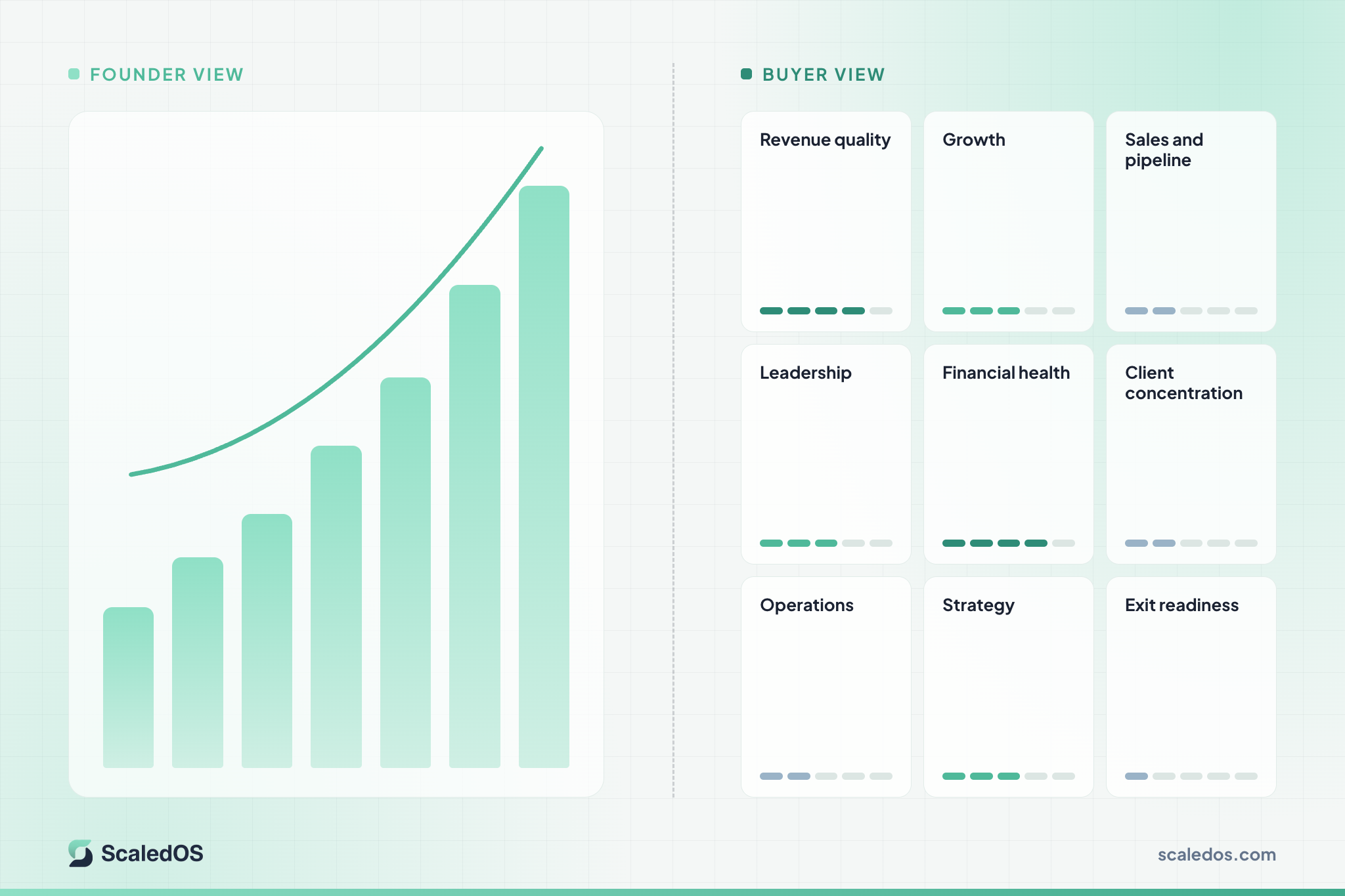
A proper benchmarking exercise maps your business across the value drivers that matter to acquirers. These metrics translate directly into the multiple (the earnings multiplier an acquirer applies to your profit to arrive at a valuation) an acquirer will apply to your EBITDA (earnings before interest, tax, depreciation, and amortisation, the standard profit measure used in agency deals).
Revenue quality
Client concentration
Leadership depth
Margin profile
Recurring revenue mix
Founder dependency
Our guide to the five levers that drive enterprise value in agencies covers each one in detail.
The hard question at this stage: If an acquirer ran due diligence on your business today, what would they find that would reduce their offer?
I ask every founder I work with to answer that question before we do anything else. Most find it uncomfortable. That discomfort is the point. You cannot fix what you have not been honest about.
Clean up the financials and the story they tell
Acquirers read your P&L looking for risk signals, not just performance. The four questions they will ask:
Revenue quality: What percentage is retained, recurring, or contracted?
Client concentration: Does any single client represent more than 15-20% of revenue? (This is a widely used guideline, not a hard rule, but concentration above this level consistently triggers acquirer concern.)
Margin trends: Is EBITDA expanding or contracting, and why?
Adjusted EBITDA: Reported EBITDA includes whatever happens to be in the P&L. Adjusted EBITDA strips out founder perks, one-off costs, and non-commercial expenses to show the true underlying profit. Are there items in yours that need removing before a buyer sees them?
If the answers to any of these are uncomfortable, now is the time to address them. Start the clean-up in months one or two, and you bank 18 to 22 months of clean, well-presented financials before any exit conversation begins. That is a meaningful asset. Waiting until month 18 is not.
Fix the proposition before you invest in growth
If your agency cannot answer “who do we serve, what do we do for them, and why do they choose us over everyone else” in two sentences, your new business pipeline will always underperform.
This is also the stage to audit client profitability. Not all revenue is good revenue. Unprofitable clients, scope-creep-heavy relationships, and clients who do not fit your positioning all dilute the story you need to tell an acquirer. Cutting the wrong clients early is one of the highest-leverage actions in the entire two-year roadmap.
Key action for stage one:
Run a full value-driver diagnostic.
Identify the top three gaps between where your business is and where it needs to be for a credible exit conversation.
Assign an owner and a deadline to each gap.
Months 7-12: Build the Operating Model
With the foundations diagnosed and the most pressing potential problem areas addressed, the second six months shift from fixing to building. The goal is a business that runs with less founder dependency and more documented, repeatable processes.
Reduce founder dependency systematically
This is the single biggest value driver most agency founders ignore until it is too late. I call it the six-month test: could your business operate, win new clients, and retain key accounts for six months without your active involvement? If the honest answer is no, that is a value problem, not just an operational one. And in my experience, most founders already know the answer before I finish asking the question.
The goal is to systematically transfer knowledge, relationships, and decision-making authority to the leadership team around you, done gradually rather than overnight. That requires:
A leadership team with genuine P&L accountability, not just operational responsibility
Client relationships owned by account directors, not the founder
A capable, experienced lead for each core function (client services, sales, operations and finance), so none of them relies on the founder
A documented decision-making framework so the team knows what they can act on without escalation
A clear org chart that would make sense to an external buyer
The test: Could your MD or leadership team run a credible process meeting with a prospective acquirer without you in the room? If not, that is the gap to close. We have covered the key decisions in depth in our practical framework on how to scale your agency’s organisational structure to support this transition.
Document the operating model
Acquirers want to see a repeatable way of delivering work, winning clients, and managing performance. Most agencies run on institutional knowledge and individual expertise instead. That is a risk in due diligence, not an asset.
The documentation needs to be credible, not exhaustive. Focus on:
Delivery playbooks: How does the agency deliver its core service? What are the quality gates?
New business process: How does a lead become a client? Who owns each stage?
Performance management: How do you know when a client relationship is healthy or at risk?
Financial cadence: What does the monthly management reporting cycle look like?
This documentation also accelerates onboarding when you hire senior leaders, which is the next stage.
Hire ahead of the growth story
The right time to hire a strong MD, COO, or Head of Client Services is before you need them, not after. Hiring at the point of pain is expensive and rushed. Bringing someone in twelve months before an exit conversation gives them time to prove their value, which strengthens the business case for the acquirer.
Key action for stage two:
Map every process that currently lives in the founder’s head.
Assign an owner for each one.
Set a deadline for documentation.
Measure founder dependency as a metric, not a feeling.
Months 13-18: Accelerate Revenue Quality
By month thirteen, the business should have clean financials, a clearer proposition, and an operating model that does not collapse without the founder. The focus can now shift to growth, specifically building the kind of revenue that acquirers pay a premium for.
Understand what revenue quality actually means
Not all revenue is valued equally. Acquirers apply different multiples depending on the predictability and stickiness of the income. A rough hierarchy:
Revenue type | Acquirer perception |
Contracted recurring (retainers, SaaS-adjacent) | Highest multiple |
Retained but not contracted | Strong, if churn is low |
Project-based with repeat clients | Acceptable, with caveats |
One-off project revenue | Discounted heavily |
Revenue concentrated in 1-2 clients | Risk flag, reduces multiple |
Shift the mix deliberately over the 18 months before an exit conversation. Contracted recurring revenue should be the target wherever the service model allows it. Retained-but-not-contracted is a strong second. Project revenue does not disappear; it becomes a smaller share of a stronger, more reliable whole.
Build the pipeline infrastructure
Growth in months 13-18 needs to be systematic, not founder-led. Practically, that means:
A defined new business process with clear ownership and conversion metrics
A content and thought leadership programme that generates inbound interest (not just referrals)
A CRM that tracks pipeline accurately, so the business can demonstrate a forward revenue view
A pricing model that reflects the value delivered, not just the hours worked
The insight most founders miss
Acquirers look at pipeline as much as they look at trailing revenue. A business with 18 months of clean financials and a credible forward pipeline is worth significantly more than one with strong trailing revenue and no visible pipeline. I have seen deals where the trailing numbers were strong, but the pipeline was thin, and the acquirer’s offer reflected exactly that. If your pipeline is underperforming, our piece on why your agency pipeline might be struggling is a useful starting point.
Protect and deepen key client relationships
Client retention is a value driver that rarely gets the attention it deserves. High churn, even if replaced by new revenue, signals fragility to an acquirer. Replacing lost clients costs more than retaining them, and heavy churn signals an unsolved delivery or relationship problem. Acquirers price that risk in. To get a sense of this, the metrics to measure are:
Net Revenue Retention (NRR): NRR measures how much revenue you retain from existing clients after accounting for upsells, expansions, and churn. A score above 100% means existing clients are spending more over time. Below 100% means you are losing ground even before factoring in new client wins.
Client tenure: What is the average length of client relationship?
Client satisfaction: Are there formal mechanisms for capturing and acting on feedback?
If NRR is below 100%, the business is losing ground with existing clients even if headline revenue is growing, and acquirers will notice.
Key action for stage three:
- Set a target for recurring or retained revenue as a percentage of total revenue.
- Build a plan to reach it.
- Track NRR monthly and treat it as a board-level metric.
Months 19-24: Build the Exit-Ready Business
The final six months are about consolidation and preparation, not transformation. If the first 18 months have been executed well, the business is already in a fundamentally stronger position. So, this phase is about making that strength visible and legible to an acquirer.
Prepare the information memorandum narrative
An acquirer’s first impression of your business comes from the story you tell about it, not just the numbers. The narrative needs to answer four questions clearly:
What does the business do, and for whom? Specific, not generic.
Why does it win? What is the competitive advantage that is not just “our people are great”?
What do the next three years look like? A credible growth plan, not an aspiration.
Why now? What is the market context that makes this an attractive acquisition today?
Most founders underinvest in this narrative, assuming the numbers speak for themselves. They do not. For a detailed look at how to frame this story, read our guide on how to frame your B2B professional services business for exit.
Get the governance right
By month 19, the business should have a functioning board or advisory structure. This matters for two reasons. First, it signals to an acquirer that the business is run with appropriate oversight, not just founder instinct. Second, it means the founder has already been practising the shift from operator to shareholder, which reduces post-acquisition risk in the acquirer’s mind.
When an acquirer reviews governance, here is what they are looking for:
Monthly board packs with P&L, pipeline, headcount, and key risks
An independent NED or advisor who can provide external validation
Documented strategic decisions with rationale, not just outcomes
A clear succession plan for the founder and any other key-person risks
Run a pre-sale due diligence exercise
Before any formal process begins, run your own due diligence. Identify every issue that would surface in a buyer’s review and fix it proactively. In our experience, the most common findings are:
Contracts with clients or suppliers that have not been updated in years
IP ownership that is ambiguous or not formally assigned to the business
Employment contracts that do not reflect current roles or remuneration
Lease obligations or liabilities that are not reflected in the management accounts
Finding these issues yourself, and fixing them, protects the multiple you have worked to build and keeps the process clean. Our piece on hidden value killers that reduce your exit multiple covers the most common ones we find in due diligence reviews.
Key action for stage four:
- Commission a pre-sale readiness review.
- Treat it like a buyer would and fix what you find.
- Build the narrative that presents the business at its best.
The One Thing Most Founders Get Wrong
They treat exit readiness as a destination rather than a discipline.
One of the most damaging myths in the agency world is that you can fix these things when you decide to sell, but you can’t. Or rather, you can try, but it will cost you significantly in time, price, and sometimes the deal itself. That discipline, applied consistently over two years, is what creates real options.
Options are the goal. Options mean choosing whether to sell, when, and to whom, on your terms, not under pressure from a difficult year, a departing co-founder, or a market window you were not ready for. Not a specific exit. Not a specific multiple. The ability to act when it suits you, not when circumstance forces your hand.
The 24-month plan is a framework for building a business that is genuinely more valuable, more resilient, and more attractive, whether you sell it or not. That is a different ambition from sprinting to an exit, and it produces better outcomes.
Where to Start
The first step is knowing where you actually stand. Where the numbers and the operating model say you stand, which is often different from where you think you stand.
ScaledOS benchmarks your business across every value driver that matters to acquirers. It shows you the gaps, prioritises the actions, and tracks your progress over time. It is the diagnostic tool we use at the start of every value-creation engagement.
If you want to talk through what the 24-month plan looks like for your specific business, start a conversation with the Scaled team. We work with agency founders at every stage of this journey, from the first diagnostic through to the exit process itself.
Two years go by faster than you think. The best time to start is now.