Summary
If you want the short version, here it us.
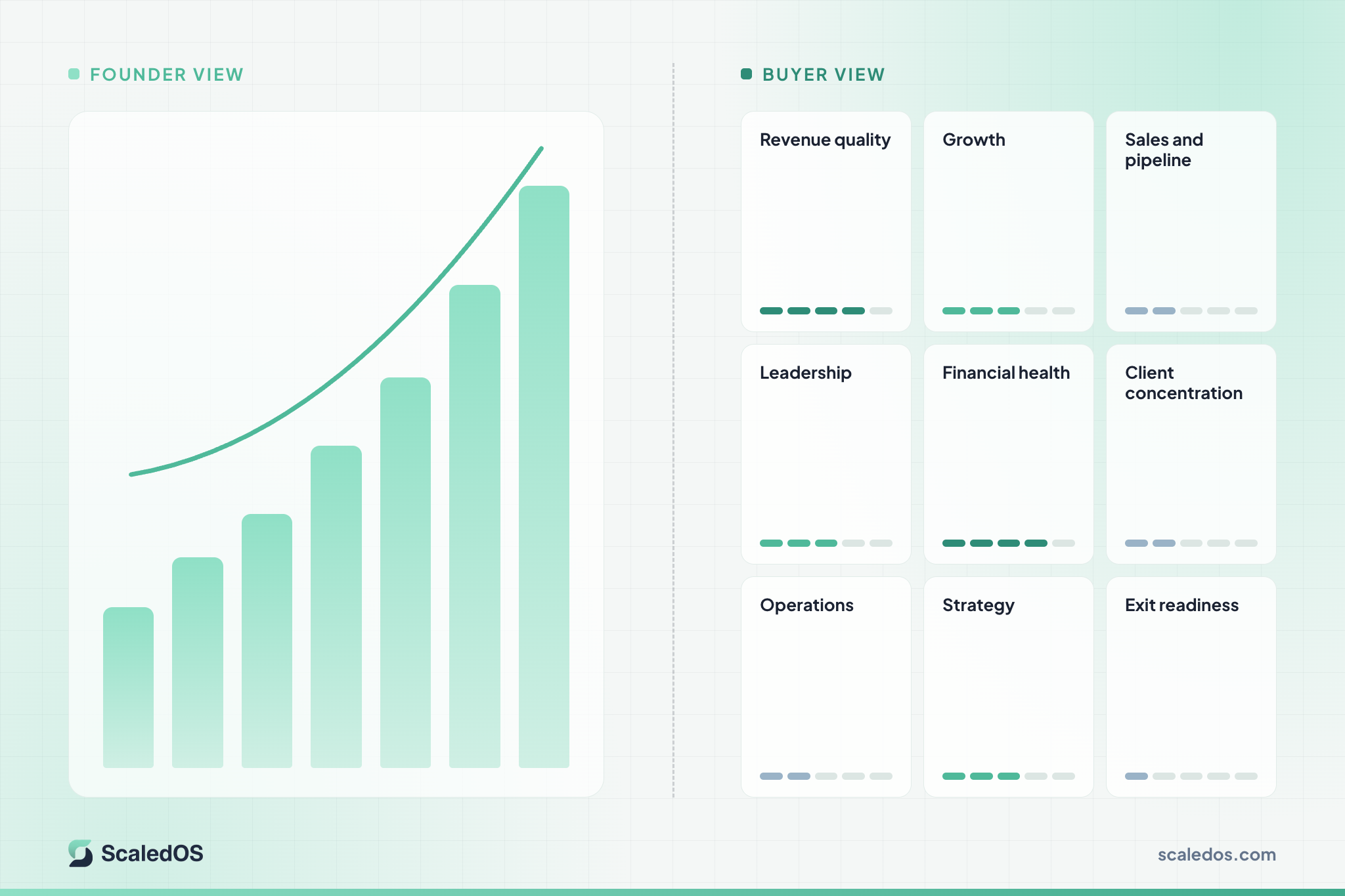
Founders and buyers usually value the same business differently. The gap comes from how predictable, legible, and de-risked the business looks from the outside.
ScaledOS turns that gap into a working framework. It gives you an enterprise value range, a health score across nine domains, and a ranked action plan.
The point is not a formal valuation. It is a directional view that helps founders, leadership teams, and revenue owners make better decisions now, not six months before a sale.
The strongest businesses are easier to underwrite. Buyers pay more for certainty, not just size.

Simon Penson
Managing Partner, Scaled
Most B2B founders I speak to have a number in their head. It’s the number they’d accept if someone made an offer tomorrow, and it’s usually based on a broker conversation from a few years back, a multiple they heard at a conference, or just a feeling built up over years of building the thing.
The problem is that number has almost nothing to do with what a buyer would actually pay.
I’ve sat on both sides of this table. I’ve built and sold businesses, and I now spend a significant part of my time advising founders through exits, sitting on boards, and working with investors who are actively looking at B2B acquisitions. The gap between what founders think their business is worth and what acquirers are prepared to pay is one of the most consistent and damaging patterns I see.
That gap is exactly what ScaledOS is built to close. It gives founders a directional view of what a buyer would realistically pay, what is holding that number down, and what to do about it.
The root cause is an information problem, not a valuation one.
Most founders are running their business on one set of metrics and being assessed by buyers on an entirely different set – and the two rarely overlap as much as founders assume.
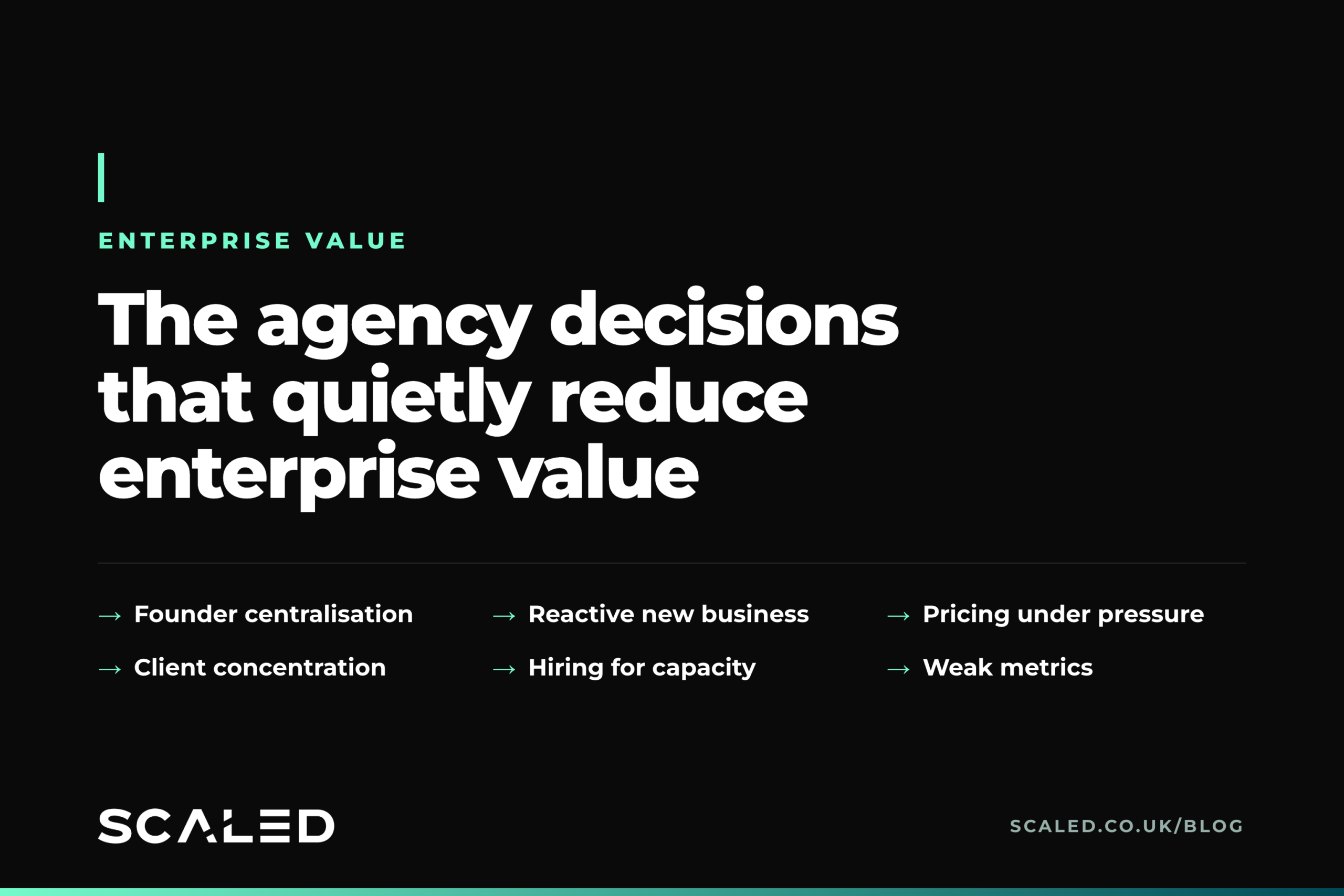
You can see that gap in three themes we’ve been exploring over the past few weeks: the new valuation divide forming across B2B services firms, the decisions that quietly reduce enterprise value, and why pipeline predictability is an operating-system problem, not a sales problem. If you haven’t read those, they’re worth your time.
How Acquirers Actually See Your Business
When a serious buyer looks at a B2B business, they’re not looking at the same dashboard you look at every morning. They’re not thinking about revenue growth in isolation, or whether you had a strong quarter. They’re building a picture of quality, and quality means something very specific in acquisition terms: how predictable is this business, how dependent is it on the founder, how defensible is the revenue, and how much of the growth will survive the transition?
A business turning over £3m with 80% recurring revenue, low client concentration, a leadership team that operates without the founder in the room, and clean management accounts will attract a materially different multiple than a business at the same revenue with project-based income, two clients representing 60% of fees, and a founder who is also the primary relationship holder for every key account.
Both founders might have the same number in their head. The market will treat them very differently.
The multiple isn’t just a reward for size. It’s a price for certainty. Buyers pay more for businesses they can underwrite with confidence, and less for businesses where the risk is hard to quantify.
This is why the valuation divide I wrote about a few weeks ago is real and growing. The B2B businesses attracting the best multiples right now are not necessarily the fastest-growing. They’re the most legible. They’re the businesses where a buyer can open the bonnet, understand what they’re looking at, and model the future with reasonable confidence.
Most founders have never been asked to make their business legible in this way. That’s not a criticism; it’s just not what the day-to-day demands. But it is exactly what an exit, a fundraise, or a board conversation requires.
The Nine Things That Actually Drive Enterprise Value
Over years of working on deals, sitting on boards, and advising founders through exits, I’ve come to see enterprise value as a function of nine distinct domains. Not revenue. Not profit margin. Nine domains, each of which a buyer will probe, each of which can move your multiple up or down.
Understanding these is the first step to closing the gap between what you think your business is worth and what the market will pay.
Revenue quality
This is the one most founders underestimate. It’s not just about how much revenue you have. It’s about how defensible it is. How much of your revenue recurs versus arrives as one-off projects? How concentrated is it across your top three clients? And if a client wanted to leave, what would it actually cost them to do so? High-quality revenue is revenue that a buyer can bank on surviving the transaction.
Growth trajectory
Year-on-year growth matters, but consistency matters more. A business that has grown steadily at 15% for four years is a more attractive proposition than one that spiked 40% and then flatlined. Buyers look at run-rate consistency and pipeline confidence, not just the headline number.
Sales and pipeline
Pipeline predictability is an operating-system problem, not a sales problem. Buyers want to see funnel metrics, close rates, and a pipeline that is managed as a system rather than held together by the founder’s relationships and instinct. Weak pipeline visibility is one of the most common reasons deals fall apart or multiples compress.
Team and leadership
The question a buyer is really asking here is: what happens when the founder leaves? Key-person dependency is a valuation killer. Succession clarity, leadership depth, and retention structures all contribute to a buyer’s confidence that the business can operate and grow without the current owner at the centre of it.
Finance and controls
This is where deals die. Reporting accuracy, audit readiness, cash flow visibility, and EBITDA reliability all come under the microscope in due diligence, and gaps here give buyers the clearest possible justification to reprice or walk. 78% of the founders who have run their numbers through ScaledOS could not produce a reliable 13-week cash flow forecast, and we see this consistently across sectors and revenue bands.
Customer retention
NPS, churn rates, and the ratio of lifetime value to customer acquisition cost. High retention is evidence of product-market fit and operational quality. It also directly influences the revenue quality score. A business with 95% gross retention tells a very different story than one with 80%.
Operations and scale
Can this business grow without breaking? Process maturity, tooling, and resilience. A buyer acquiring a services business doesn’t want to find that the delivery model is entirely dependent on three senior people who can’t be replaced. Documented processes and scalable operations reduce risk and support a higher multiple.
Market position
How much of a client’s total spend you capture, the strength of your competitive moat, and brand recognition in your market. This is about whether the business has earned a defensible position in its market, or whether it is one of many undifferentiated options competing on price and relationships.
Strategic innovation and IP
Tech stack, proprietary data, and any genuine intellectual property. For agencies, SaaS businesses, and MSPs alike, the question is whether there is anything in the business that a buyer couldn’t replicate or acquire elsewhere. IP and proprietary capability are increasingly important differentiators in B2B valuations.
Most founders are strong in two or three of these domains and have significant gaps in others. The problem is that buyers assess all nine. A single weak domain, particularly in revenue quality, team dependency, or finance, can compress the multiple across the entire business.
The Same System Works When You’re Not Selling
I want to be clear about something before I go further. This is not just exit planning content, and the nine domains above are not a due diligence checklist for founders who are twelve months out from a sale. They are the foundations of a well-run business.
A business with strong revenue quality is a business with predictable cash flow. A business with low key-person dependency can scale without the founder being the bottleneck. A business with clean finance and controls makes faster, better decisions. These things matter on a Tuesday morning in November just as much as they matter in a data room.
The mistake most founders make is treating enterprise value as a destination rather than a direction. Enterprise value is built over years, through the operating decisions you make every quarter – not in the six months before you sell. The founders who achieve the best exits are the ones who have been running their business with one eye on what a buyer would see, not because they’re always planning to sell, but because it produces a better, more resilient business.
The same is true for revenue leaders. If you’re accountable for the commercial performance of a B2B business, the sales and pipeline domain isn’t just a valuation input. It’s a signal about the quality of your revenue engine. Weak pipeline visibility, poor close-rate data, and over-reliance on founder relationships are not just exit risks. They are operational risks that are costing you growth right now.
The framework is the same regardless of where you’re sitting.
Where ScaledOS Comes In
We built ScaledOS to solve the information problem I described earlier. It’s an enterprise-value operating system for B2B founders, built on a methodology derived from a real private-equity valuation framework. Directional by design, it shows you what an acquirer would realistically pay for your business today and what’s holding that number down, without the formality of a valuation or the spin of a broker’s pitch document.
It takes about 20 minutes, with no integrations and no card required. You answer a focused set of questions based on your own figures, and it produces four things:
An enterprise value range and EV multiple, calculated by applying sector-specific multiples to your adjusted earnings, then weighted against your nine domain scores to reflect the actual risk and quality profile of the business, not just its size
A health score across all nine domains, each benchmarked against your sector and revenue band using data from 20+ real B2B transactions, so you can see where you sit relative to comparable businesses
A ranked action plan, built by mapping your weakest domain scores against the value drivers that carry the most weight in B2B acquisitions, so the actions at the top of the list move the multiple, not just the metrics
A Buyer’s Verdict, simulated buyer commentary on your business based on your scores, translating numbers into the language an acquirer would actually use in a deal conversation
The Buyer’s Verdict is the feature I’m most proud of. No comparable tool does this, and founders who have used it tell us it’s the first time they’ve understood how their business looks from the outside.
The team behind ScaledOS has built, sold, invested in, and governed B2B businesses, including a 280-person agency sold for north of £35m and over 100 B2B investments via Haatch. The framework comes from the deal table, not a textbook.
Once you’ve run your initial score, ScaledOS tracks your progress. Re-scoring each quarter shows you whether your enterprise value is moving in the right direction and which domains are improving or stalling. That quarter-on-quarter view is where the operating-system part of the name earns its keep.
ScaledOS tells you what a buyer would see, not what you want to hear. That’s the point.
What Happens When You Know Your Number
I’ve watched founders go through this process and come out the other side with a fundamentally different relationship to their business – not because they suddenly have an exit plan, but because they finally understand what they’re building toward. When you know your EV range and your health scores, a few things change.
First, you stop making decisions in a vacuum. The question is no longer “should we invest in this?” It becomes “does this investment improve one of the nine domains that matter to a buyer?” That’s a sharper filter. It doesn’t eliminate hard calls, but it gives you a framework for making them with the long-term value of the business in mind.
Second, you can have better conversations with your board, your investors, and your leadership team. Enterprise value is a shared language, and when everyone in the room understands which domains are strong and which are holding the multiple down, the conversation about priorities becomes much cleaner.
Third, and most importantly for founders who are thinking about an exit at some point, you give yourself time. The founders who get the best outcomes are not the ones who start preparing six months before they want to sell. They’re the ones who have been building a buyer-ready business for years, tracking the right metrics, closing the gaps, and arriving at the deal table with a business that is already legible.
Authoritas achieved an 8x-plus revenue exit after 111% revenue growth in year one of working with Scaled. Saulderson Media delivered 3x EBITDA and revenue growth over two years. In both cases, the work started long before the exit conversation. That’s the pattern.
You don’t have to be planning to sell to benefit from knowing what your business is worth and why. But if you are, the time to start is now, not when you’ve already found a buyer.
If you want to go deeper on the mechanics before you score, our Exit Blueprint covers the full valuation framework, from earnings quality to risk de-risking, in detail.
Get free access to ScaledOS and run your first enterprise value score. It takes 20 minutes and costs nothing. The number you come out with might surprise you, and knowing what’s holding it down is where the real work begins.
Frequently Asked Questions
ScaledOS is an enterprise value operating system for B2B founders. It shows what an acquirer would realistically pay for a business, what is holding that value back, and which actions are most likely to improve it.
No. ScaledOS is directional, not a formal valuation. It is designed to help founders understand their likely value range, benchmark the business against key value drivers, and prioritise what to improve next.
ScaledOS measures nine enterprise value drivers, including revenue quality, growth trajectory, sales and pipeline, team and leadership, finance and controls, customer retention, operations and scale, market position, and strategic innovation and IP.
It takes about 20 minutes to complete. There are no integrations and no card required, so founders can answer the questions manually using their own figures.
You get an enterprise value range and EV multiple, a health score across the nine domains, a ranked action plan, and a Buyer’s Verdict that translates the scores into buyer language.