Key Takeaways
- The valuation divide separates businesses buyers can underwrite from those they have to take on faith. The gap in outcomes is significant: 3-5x EBITDA with heavy earn-outs versus 7-10x with the majority paid upfront.
- The three value drivers that move the price are quality of revenue, founder independence, and margin quality with financial visibility.
- Growth alone does not close the divide. Revenue concentrated in the founder, or in two or three clients, is risk a buyer will price in.
- Buyers are not paying a premium for “AI” as a label. They are paying for what AI does to the P&L: higher margin per head, lower delivery costs, expanding profitability.
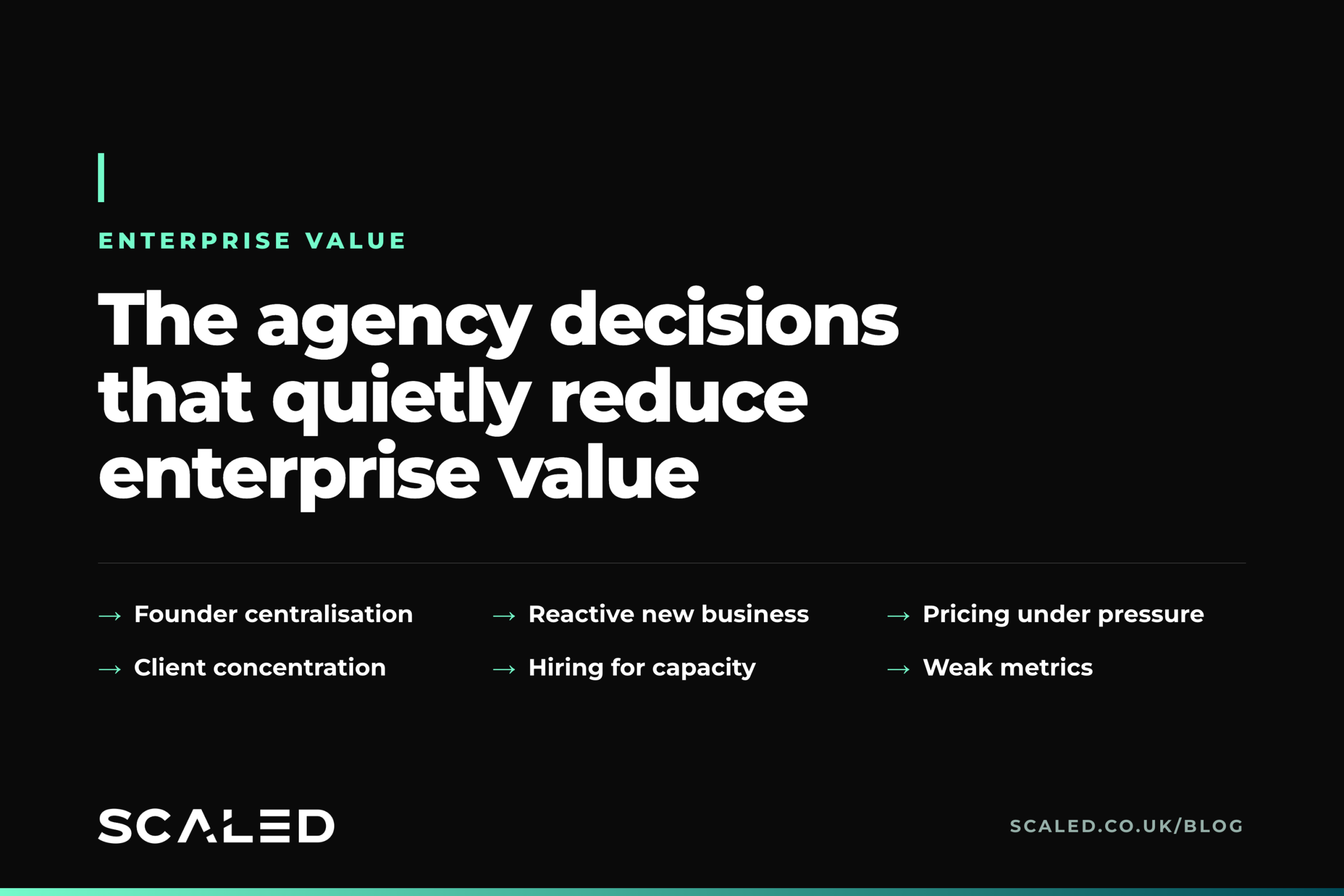
- The things that move the multiple take 18 months to two years to fix. Starting early is the single biggest lever a founder has.

Simon Penson
Managing Partner, Scaled
Two businesses. Similar revenue. Similar growth rates. One sells for 7x, with the majority paid upfront. The other sells for 4.5x, with more than half in an earn-out tied to the founder staying on for three more years. Same market, same moment, very different outcomes.
That gap is the valuation divide, and it is widening.
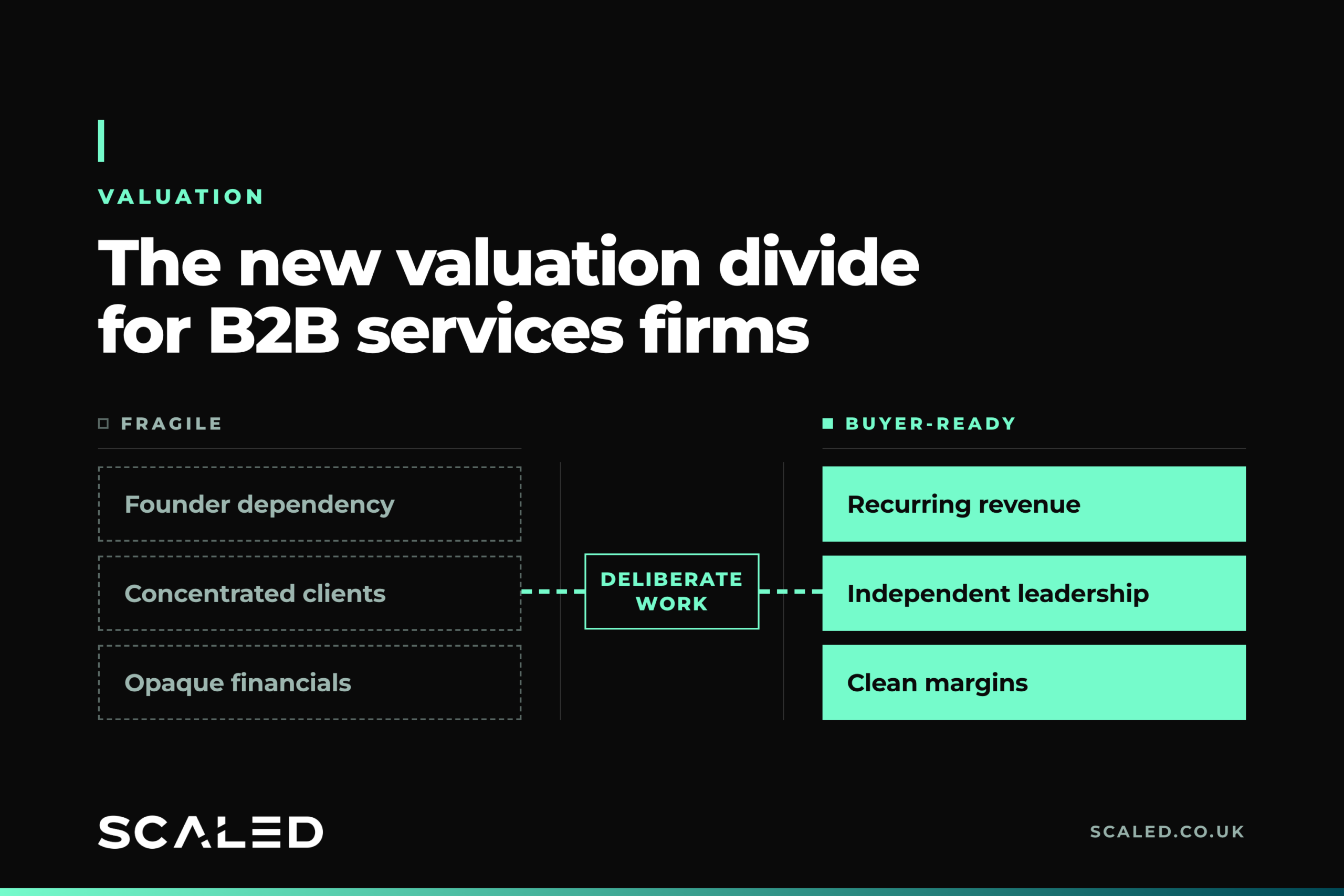
The valuation divide is the gap between businesses a buyer can underwrite and businesses a buyer has to take on faith. Premium firms have predictable revenue, a business that runs without the founder, and margins that prove the model works. Discounted firms have growth, but it is growth that depends on heroics.
That definition matters because most founders I speak to are measuring the wrong things. They track top-line revenue and year-on-year growth, but buyers ask entirely different questions. Understanding those questions, and answering them honestly, is the difference between a life-changing exit and a disappointing one.
Why Has the Divide Widened in the Last Two Years?
Money got expensive, and buyers got careful. That is the short version.
When debt was cheap, buyers paid for potential and fixed the problems later. A fragile client base, a founder who was the business, a P&L nobody could fully explain: these things got priced in optimistically because the cost of being wrong was manageable. That calculus has changed.
Now, diligence stress-tests every assumption. Anything that looks fragile gets priced down or chipped at completion. Buyers are not being difficult; they are being rational. The cost of capital makes them so.
AI has added a second layer of doubt. Buyers are asking whether your service, team structure or pricing model will even exist in its current form in three years. That is not a threat to panic about. It is a lens, and understanding how buyers are using it changes how you prepare.
The middle has hollowed out. PE still has plenty of capital to deploy, but it is concentrating on fewer, better assets. The best businesses run competitive processes and get strong terms. Everyone else is getting long diligence, earn-outs and retention-heavy structures. There is less and less in between.
What Does Being on the Wrong Side Actually Cost?
Let me make this concrete, because the numbers are sobering.
In UK B2B services, businesses on the wrong side of the divide are trading at roughly 3 to 5x EBITDA, often with a significant chunk deferred into an earn-out they may never fully see. Businesses on the right side, with recurring revenue, a proper second-tier leadership team and clean numbers, are getting 7 to 10x and above, with more cash on day one. These are my ballpark observations of the UK market, not sourced data, but the pattern is consistent.
In software, it is similar. Low-growth, high-churn SaaS is trading at 1 to 3x ARR. Efficient growers with strong net revenue retention still command 5x and above.
The structure matters as much as the multiple
Two deals at the same headline multiple can be worth very different amounts once you look at what is upfront versus what is at risk. Here is what that looks like in practice.
A digital agency of around £6m revenue and just under £1m EBITDA went to market expecting 7 to 8x on the back of three years of strong growth. Diligence told a different story. Two clients made up almost half the revenue. The founder personally owned every senior relationship. Nobody could confidently say which service lines actually made money.
The offer came back at 4.5x, with 60% deferred into a three-year earn-out tied to the founder staying in the business. The headline looked respectable. The founder walked away with less than £2m on day one instead of the £6m+ they had planned for, and signed up for three more years of the job they wanted to leave.
Almost all of that gap was fixable with 18 months of preparation.
The line that has stayed with me from a buyer conversation sums it up: “We’re not buying your last three years. We’re buying the next three, and right now you’re asking us to bet that you’ll still be here to deliver them.”
That is what commercial due diligence uncovers every time. Not the headline number, but the structure underneath it.
What Are Buyers Actually Paying For Now?
When I sit in a buyer conversation or work with a founder preparing for a process, the same three things come up every time. Get these right, and the conversation is about upside. Get any one of them wrong, and it becomes the whole conversation.
1. Quality of revenue
How much of your revenue is recurring or contracted? How concentrated is it? How much of it retains and grows year on year? A business where 70% of revenue renews automatically, and clients spend more each year is a fundamentally different asset from one that starts at zero every January.
Revenue concentration catches founders out most often. If two or three clients represent 40% or more of your revenue, a buyer is not just pricing your business; they are pricing the risk that one of those clients leaves.
2. Founder independence
Is there a leadership team that genuinely runs the business, or does every big client relationship and every significant decision run through one person? Building a leadership team that reduces founder dependency is not just a management improvement. It is a direct value driver.
Buyers aren’t paying for a brilliant founder. They are paying for a brilliant business. The difference is meaningful, and it shows up in the multiple.
3. Margin quality and financial visibility
Can the business show where it makes its money, by client and by service line, with forecasting a buyer can trust? Most founders know their overall margins but have no idea what “good” looks like for a business of their size and model. They think a 15% EBITDA margin is solid until they see similar businesses running at 20 to 25% with the same revenue.
If those three value drivers are strong, buyers lean in. If any one is weak, it becomes the whole conversation.
ScaledOS: See exactly where value is leaking in your business
ScaledOS benchmarks your P&L line by line against peers, so you can see precisely where value is leaking: people costs, delivery costs, overheads. It also surfaces founder dependency and finance function maturity, the things founders tend to be too close to judge honestly.
If those three value drivers are strong, buyers lean in. If any one is weak, it becomes the whole conversation.
Are Buyers Paying a Premium for “AI”?
Not for the label. When every pitch deck has AI on slide two, it stops being a differentiator and becomes a question mark.
Buyers are not paying for a tools list, a few pilots and a slide about “transformation”. They are paying for what AI does to the business. Specifically, they will pay for higher gross margin per head, faster delivery, new products with real revenue attached, and a business model redesigned around AI rather than threatened by it.
AI as a label versus AI in the numbers
The distinction is straightforward. AI as a label is a narrative you have to defend in diligence. AI that shows up in the numbers defends itself.
Revenue per head going up. Delivery costs coming down. Utilisation improving. Margins expanding quarter on quarter. That is what buyers are looking for. Not the story, the P&L impact.
When I hear a founder say “we’re an AI-first agency”, my first question is: “Show me your revenue per head over the last four quarters.” If it is flat or declining, the label is not doing the work they think it is.
The founders who cross to the right side of the divide are the ones who rebuilt their model around AI, not the ones who added AI to their marketing.
The Contrarian View: “Just Keep Growing, and the Valuation Will Take Care of Itself”
This is the most common bad advice I hear founders receive, and it is genuinely harmful.
Growth without the right foundations can make the valuation problem worse, not better. More revenue concentrated in the founder. More complexity. More risk for a buyer to price in. A business that has grown quickly on one or two key relationships or heroic personal effort is less attractive to a buyer; it is more fragile.
The second piece of bad advice is equally damaging: “Worry about exit readiness when you’re ready to exit.” By then it is too late. The things that move the multiple (quality of revenue, founder independence, financial visibility) take 18 months to two years to fix. Buyers can tell the difference between a business built well and one dressed up for sale.
What crossing to the right side actually looks like
A B2B professional services firm of around 60 people was founder-led, project-based and lumpy: great years followed by nervous ones. Over roughly two years, they moved from 20% to just over 60% retained revenue, built a leadership team that owned client relationships and P&L lines, and rebuilt their reporting so they could show margin by client and forecast six months out with confidence.
Nothing glamorous. Just the foundations.
When they went to market, they ran a competitive process. The conversation was about upside rather than risk. They achieved a multiple roughly double what they would have been offered two years earlier, with the majority paid upfront.
That is what raising investment or running a sale process looks like when the foundations are right. The process itself becomes easier because the business answers its own questions.
Having a board-level perspective in the room during that preparation period made a material difference. Not because it changed the strategy, but because it kept the founder honest about which problems were genuinely fixed and which just looked better on paper.
What Should You Check This Quarter?
Start with the simplest signal. Take your top five clients and ask two questions:
- What percentage of total revenue do they represent?
- Would they stay if you stepped away tomorrow?
If the answer is “a lot” and “I’m not sure”, you are on the wrong side of the divide. That is not a counsel of despair. It is a starting point, and it tells you exactly where to focus first.
But two questions only tell you whether a problem exists. They don’t tell you how deep it runs, where value is leaking in your P&L, or how your margins, founder dependency, and finance function compare to businesses of similar size and model. That is the gap most founders are operating in: they know something is off, but they cannot see it clearly enough to fix it in the right order.
ScaledOS gives you that picture. It benchmarks your business across every value driver that matters to a buyer, shows you where you stand against peers, and gives you a prioritised view of where to focus in the next 18 months. Businesses that achieve strong multiples with the majority paid upfront almost always had that clarity early and acted on it.
Benchmark your business with ScaledOS
Know where you stand before it matters
If you want to understand which side of the divide your business sits on, and what it would take to move it, that is the conversation we have with founders at Scaled. Not a sales pitch. An honest assessment of where the gaps are and whether the timeline is realistic.
Frequently Asked Questions
The valuation divide is the gap between businesses a buyer can underwrite and those a buyer must take on faith. Premium businesses have predictable revenue, a leadership team that runs the business independently of the founder, and margins that prove the model works. Businesses on the discounted side often have growth, but it depends on heroics, and buyers price that risk into the deal structure.
The gap is significant in both the multiple and the deal structure. In UK B2B services, businesses on the wrong side are typically trading at 3 to 5x EBITDA, often with a large proportion deferred into an earn-out. Businesses on the right side are achieving 7 to 10x and above, with more consideration paid upfront. Two deals at the same headline multiple can be worth very different amounts once you look at how much is at risk versus guaranteed.
In my experience, the core value drivers (revenue quality, founder independence and financial visibility) take 18 months to two years to fix in a way that holds up in diligence. It is not a quick process, but it’s manageable if you start early enough. The founders who get the best outcomes almost always treat exit readiness as an ongoing discipline rather than a pre-sale exercise.
Not for the label. Buyers are not paying a premium for “AI” as a claim; they are paying for what AI does to the unit economics of the business. Higher revenue per head, lower delivery costs, and expanding margins are the signals that move the price. A business that has genuinely rebuilt its model around AI will show that in the P&L. A business that has added AI to its marketing will be asked to prove it in diligence, and that is a harder conversation.