TL;DR: More than 100 UK B2B founders have run their numbers through ScaledOS. The data shows a consistent pattern: most scale-ups sit on more enterprise value than they realise, and the fastest gains come from five fixable areas.
A month ago, Scaled quietly opened ScaledOS to an early beta cohort. No big launch, no fanfare. Just an invitation to a group of B2B founders to run their numbers through the platform and see what came back.
More than 100 founders have now run their numbers through ScaledOS. Each came away with:
An Enterprise Value (EV) score – ScaledOS’s measure of how ready a business is for growth, investment, or exit
A Business MOT – a structured health check that shows where value is leaking and where it can be strengthened
The feedback has been warm, honest, and genuinely useful, and we’re grateful to every founder who gave us their time. Across the cohort, valuations ranged from £350k at the smaller end to £86m at the top.
But the feedback isn’t the interesting part. The interesting part is what the aggregate data is starting to reveal about the opportunity sitting inside UK B2B scale-ups right now. Because across the board, the picture is the same: founders have built something real, and most of them are sitting on considerably more potential than they realise.
Here’s what the first month has surfaced.
Quick snapshot
| Metric | What the beta cohort showed |
|---|---|
| Founders assessed | 100+ |
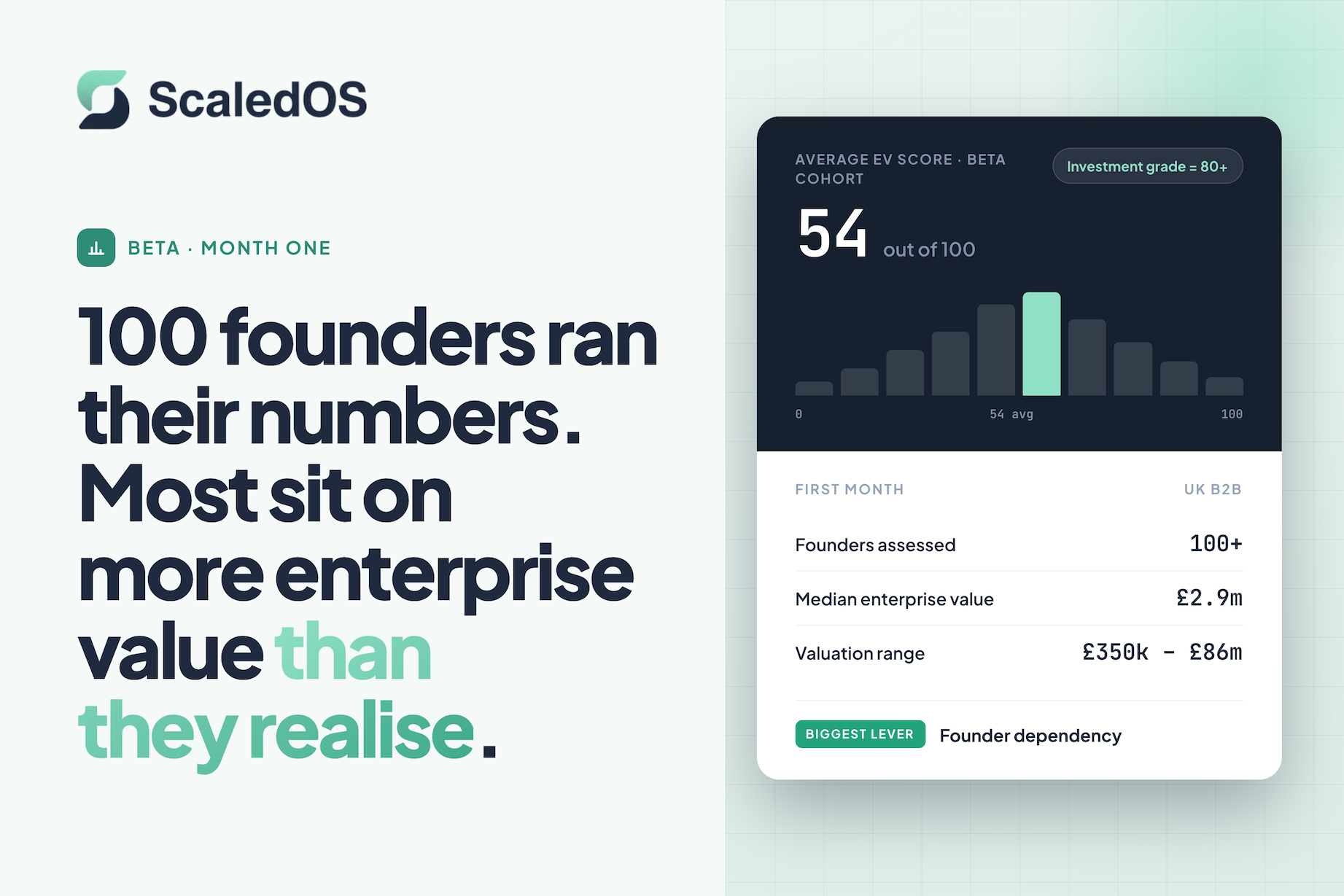
| EV score average | 54 out of 100 |
| Median enterprise value | £2.9m |
| Valuation range | £350k to £86m |
The Big Picture
The median enterprise value across the cohort was £2.9m, with individual valuations ranging from £350k to £86m. For context, the British Business Bank’s Small Business Equity Tracker 2026 (PDF) puts the median pre-money valuation across the UK equity market at £6.4m, suggesting many scale-ups have a meaningful gap to close before they become credible candidates for institutional capital.
More telling than the absolute number is the average EV score: 54 out of 100. The typical business assessed is running at roughly half of what investment-grade looks like. Not broken. Not failing. Just sitting on considerably more potential than it has unlocked yet.
Key finding: The gap between a 54 and an 80 on the EV score is not luck or market timing. It is a small number of fixable issues, showing up in the same places, every time.
When we looked at where those points are being left on the table, five opportunities came up again and again.
Five Opportunities Hidden Inside Most UK Scale-Ups
1. Reducing founder dependency unlocks serious valuation upside
Around 68% of the cohort scored in the lower bands for founder dependency, meaning the key relationships, commercial decisions, and day-to-day culture still route through one or two people at the top. That’s not unusual at this stage of growth. It’s also one of the highest-leverage things a founder can change.
Buyers and investors pay a premium for businesses that run without the founder in the room. The businesses in the cohort scoring well here had done the unglamorous work of building a management layer beneath them. ScaledOS identifies exactly where that dependency sits and what to do about it, before it becomes a drag on your valuation conversation.
2. Predictable revenue is worth more than fast revenue
Median recurring revenue across the cohort sat at 31%, and nearly four in ten businesses had a single client accounting for more than 25% of turnover. The opportunity here is significant: shifting even a portion of revenue from project-based to recurring, retainer, or subscription models has an outsized effect on the multiple a business can command.
Founders tend to focus on growth. Investors focus on repeatability. ScaledOS benchmarks your revenue mix against comparable businesses and shows you where the quick wins are.
3. Better financial visibility means a better valuation story
The finance function is often the last thing to catch up with a fast-growing business. Across the cohort:
Roughly six in ten founders were navigating by cash-in-bank rather than management accounts
Only 22% could produce a reliable 13-week cash flow forecast on demand.
EBITDA quality varied widely, with personal costs, one-offs, and owner add-backs sitting unexamined in the P&L.
None of this is a criticism. It’s a growth-stage reality. But the businesses that get ahead of it early, with clean numbers and a clear financial narrative, are the ones that defend their valuation in a data room. ScaledOS flags the gaps and gives you a roadmap to close them.
4. Knowing what your business is actually worth changes everything
Before founders saw their benchmarked EV, we asked them what they thought the business was worth. On average, the self-estimate was 2.4x away from the benchmarked figure. For a small group, that was a pleasant surprise: they were sitting on more than they realised. For most, it revealed an expectation that needed recalibrating.
Either way, knowing is better than guessing. Founders who discover that gap now, with time to act, are in a far stronger position than those who find out in a live transaction. ScaledOS gives you that clarity before it matters most.
5. The services-to-software shift is a genuine value multiplier
Gross margins across the cohort spread widely, with services-heavy, software-light businesses clustering at lower multiples. The market is repricing the difference between a business that sells hours and one that sells outcomes, and it’s doing it quickly.
Businesses in the cohort that started building recurring, productised, or software-assisted revenue around their core service scored materially better on both margin and multiple. This convergence of services and software into a single model is the defining shift of the next 24 months. ScaledOS helps you see where you sit on that spectrum and what moving along it could mean for your valuation.
What the Data Is Really Telling Us
Most UK B2B scale-ups are worth more than they think, and with the right visibility, they can close the gap faster than they expect.
The British Business Bank (PDF) reported that UK smaller businesses raised £12.3bn in equity in 2025, with investors concentrating capital more selectively than ever. In that environment, the founders who know their numbers, understand their value drivers, and can articulate a credible growth story will attract capital. The ones who can’t will watch it flow elsewhere.
The five themes above are not problems. They are levers:
Founder dependency reduced means a business that commands a higher multiple
Recurring revenue increased means a valuation story investors want to back
Financial hygiene improved means a data room that holds up under scrutiny
Valuation clarity gained means negotiating from a position of knowledge, not hope
Model evolution started means joining the cohort of businesses the market is repricing upwards
The gap between a 54 and an 80 on the EV score is not luck. It is a small number of deliberate moves, made early enough to compound. ScaledOS shows you exactly what those moves are.
Find Out What Your Business Could Be Worth
ScaledOS gives B2B founders something most never get: an honest, benchmarked picture of their enterprise value, what’s driving it, and what would move it higher.
It takes about an hour. It’s completely free. And you’ll come away with an Enterprise Value score, a Business MOT, and a clear view of exactly where your biggest opportunities sit, ranked by impact.
More than 100 founders have already been through it. The ones acting on what it showed them are building businesses that will be worth materially more in 12 to 24 months. Not because the market changed, but because they did.
Run your EV score, Business MOT, and financial benchmark at scaledos.com. Find out what your business is really worth today, and what it’s capable of becoming.