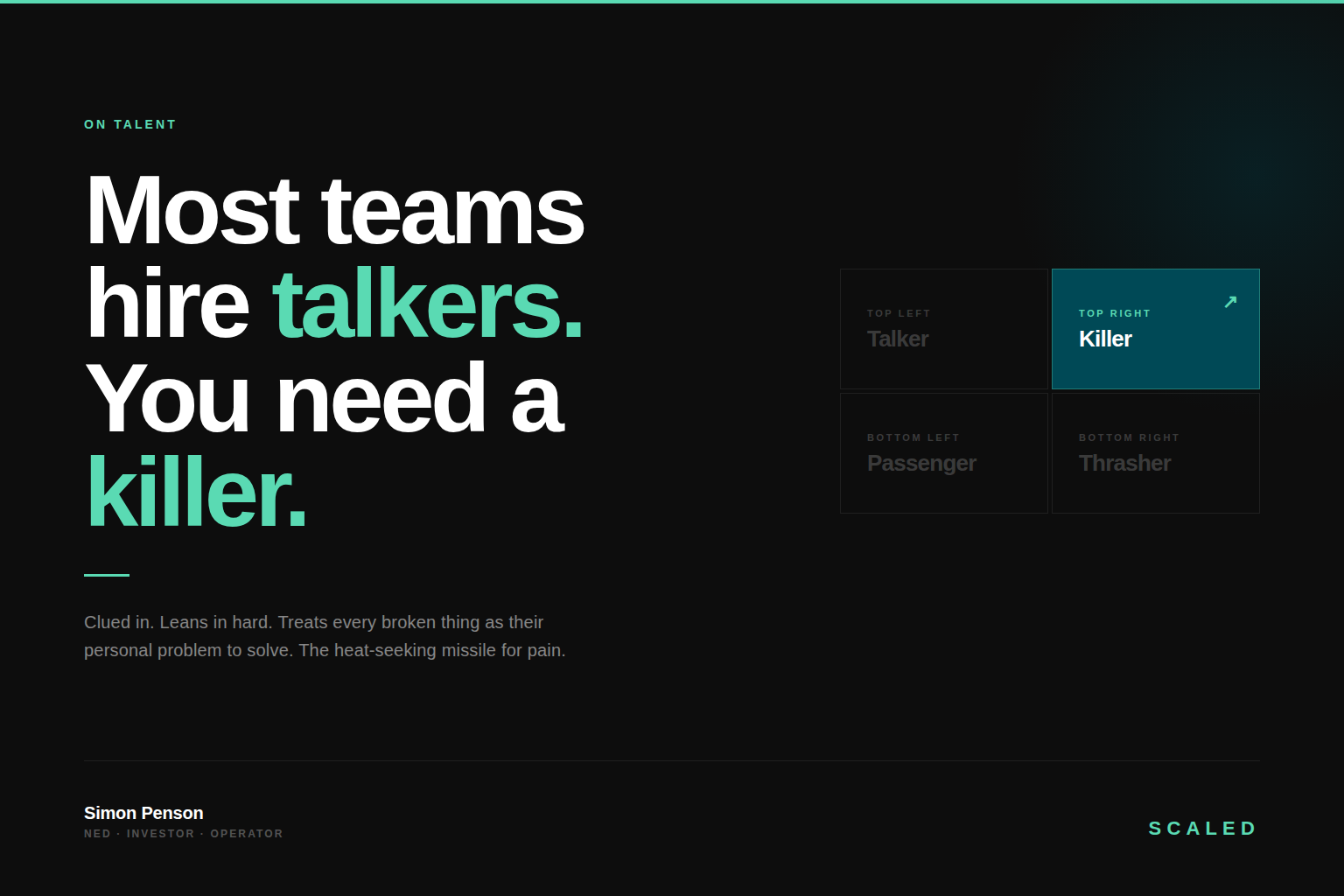
In this post, Scaled founder Simon Penson — who built a digital agency to 270 people and £23m revenue before selling to InterPublic Group and has since invested in over 100 businesses through Haatch Ventures — shares the employee framework he wishes he’d had from day one.
After 25 years of building, backing and sitting on boards, I’ve come to one uncomfortable conclusion about how most businesses hire.
I’ve interviewed thousands of people. Sat across the table from graduates, senior hires, C-suite candidates, agency heads, SaaS founders and everything in between. I’ve built a business from nothing to 270 people and a £23m revenue run rate before selling it to a global network. I’ve invested in north of 100 B2B businesses through Haatch. And now, as a NED and advisor across a portfolio of growth-stage companies, I spend a significant part of my working life helping founders think about people, structure and performance.
In all of that time, across all of those contexts, I’ve come to one uncomfortable conclusion about how most businesses hire.
They optimise for the wrong thing.
They build processes designed — consciously or not — to find people who are brilliant at presenting the idea of work. People who are articulate, well-prepared, who know how to land a great first impression and talk fluently about what they would do. And then they wonder why, six months later, the wheels are still turning but nothing is actually moving.
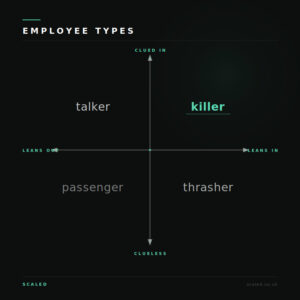
There’s a framework I came across recently that cuts through all of this noise. It’s a simple two-axis matrix — clued in versus clueless on the vertical, leans in versus leans out on the horizontal. Four quadrants. Four employee archetypes.
The talker. The passenger. The thrasher. The killer.
And before I unpack what each of those means in practice, I want to tell you what I’ve learned from seeing all four of them up close.
The Matrix in Reality
The framework sounds simple. It is. But the precision of it is what makes it powerful.
The talker sits top-left. Clued in — they understand the business, know the landscape, can articulate the strategy back to you with impressive fluency. But they lean out. They’re the person in the meeting who always has a sharp observation, a well-framed take, a useful analogy. And then, when it comes to doing the actual work, they find reasons why it’s complicated, why it needs more thinking, why they need to align a few more people first.
I’ve hired talkers. I’ve promoted talkers. They’re seductive because intelligence is easy to mistake for impact. In a large business — in a consultancy, in a corporate, in a late-stage organisation with established infrastructure — talkers can actually survive for a long time. The system absorbs them. The work gets done anyway.
In a growth business, they’ll cost you dearly.
The passenger sits bottom-left. Clueless and leans out. This one’s simpler to diagnose — they’re along for the ride, collecting a salary, doing the minimum. Every business has them. Most businesses tolerate them longer than they should because removing them feels hard, because they’re often pleasant, because the friction of change seems greater than the drag they create.
It never is.
The thrasher sits bottom-right. Leans in hard — huge energy, huge effort, enormous visible activity — but clueless. This is the one that catches people out. Thrashers look like killers from a distance. They’re in early, leave late, talk loudly about what they’re working on. But without the awareness and judgment that comes from being truly clued in, all that energy moves in the wrong direction. I’ve seen thrashers burn through goodwill, create organisational noise, and occasionally break things that were working.
The hardest management conversation I’ve ever had wasn’t about under-performance. It was about re-directing a thrasher whose energy was extraordinary but whose compass was broken.
And then there’s the killer.
What a Killer Actually Looks Like
Top right. Clued in and leans in hard.
Tanay Tandon, the founder of Commure (formerly Athelas), has a phrase for this type of person that I think is the most accurate description I’ve ever encountered: a heat-seeking missile for pain.
The killer doesn’t wait to be briefed. They don’t need a project plan or a scope document or a steering committee. They have an almost addictive instinct for seeking out the things that are broken — in the product, in the customer experience, in the go-to-market motion, in the operations — and they treat every one of those broken things as their personal problem to solve.
Here’s what that looks like in practice. On a given day, a killer might read through a hundred support tickets, solve twenty or thirty of them, trace the underlying cause back to a product or process gap, design an improvement, write it up, get in front of the right engineers, push for a timeline, and then check in daily until it ships. In one day. While also watching thirty demo recordings and rebuilding part of the sales methodology because they noticed a pattern in the close-lost data.
Shockingly, at mediocre companies, that entire process would represent six to twelve months of work. Support escalates the tickets. A CSM creates a mega-ticket. A PM calls a discovery session. A project board gets created. The fix gets slated for Q4 of next year.
The killer cuts through all of that with a clarity and urgency that is almost unsettling to watch.
I’ve met killers at every level. I’ve hired them straight out of university and watched them outperform people with twenty years of experience within eighteen months. I’ve seen them arrive mid-career from entirely different sectors and reframe how a whole function operates within a quarter. And I’ve occasionally — too rarely — found them already embedded in businesses I’ve invested in, quietly holding entire departments together while the noise happens elsewhere.
They’re not always the loudest person in the room. In fact, they rarely are. They’re usually already three steps into solving the problem you haven’t admitted you have yet.
The “Strategy Plane” Problem
The opposite of the killer isn’t the passenger. It’s the talker operating at what I’d call the strategy plane.
I want to be careful here, because strategy is genuinely important. Understanding where a business should go, how the market is moving, what the competitive dynamics look like — that’s real and valuable work. I’ve spent much of my career doing it.
But there is a version of strategy that is really just a sophisticated avoidance mechanism. A way of staying upstream of the hard, messy, uncomfortable work of actually executing on things.
I see this pattern in boards. In senior leadership teams. In agencies and consultancies especially, where the premium placed on thinking and framing is enormous and the accountability for outcomes can be diffuse. People who are extraordinarily fluent at diagnosing the problem and entirely absent when it comes to doing anything about it.
Tandon describes them as folks who “point at the problem, raise the alarm, and then contribute to high-level strategy.” They think they’re being value-add. They aren’t. At best, they’re adding noise. At worst, they’re consuming oxygen that could be going to the people actually trying to fix things.
In larger, plateauing organisations, these people get promoted. The system rewards articulate people who can navigate politics and present well to leadership. That’s a corporate survival skill, and it exists for a reason.
In a fast-growing, product-driven business? They should be performance-managed out quickly. And I say that as someone who has made the mistake of not doing that fast enough, more than once.
The Hiring Problem
Here’s where this gets uncomfortable for most founders and operators.
Our hiring processes are almost perfectly designed to identify talkers.
Think about it. CVs reward people who can frame their history compellingly. First interviews are conversations — they test how someone communicates, not how they execute. Even the best competency-based interview frameworks are designed to elicit stories about what someone did, which a skilled talker can reconstruct, embellish and deliver with total conviction.
The killer is often harder to interview than the talker. They may not have the polished narrative. They may be more interested in asking you about your biggest operational headache than in selling themselves. They may seem almost uncomfortably direct. In an interview context designed to reward fluency and self-presentation, they sometimes don’t shine.
This is a real problem. And I don’t have a perfect solution to it. But I do have a set of things I’ve come to rely on.
Work samples over hypotheticals. Give people a real problem — a messy, ambiguous, genuinely thorny problem from inside the business — and see what they do with it. Don’t ask them how they’d approach it in theory. Give them a week and see what they come back with. The killer will go three levels deeper than you expected. The talker will produce a beautiful framework and no answers.
Reference calls that ask the right question. Not “what was X like to work with?” That gets you nothing. Ask instead: “What’s the hardest problem X ever had to solve, and what did they actually do?” Then listen for specificity. Killers leave a trail of specific, documented, measurable things they fixed. Talkers leave impressions.
Watch what happens when things go wrong. The talker moves away from the problem. The killer moves toward it. If you can create a moment in the interview process where something slightly goes wrong — a brief you set that has a deliberate gap in it, a session that runs long, a question that genuinely has no right answer — you can learn an enormous amount from how someone responds to friction.
What to Do When You Find One
Promote them fast. Faster than feels comfortable. If you wait until the organisation is ready for it, you’ll lose them.
Give them equity. Unreasonable amounts, as Tandon puts it. Because the value a single killer creates in an organisation is genuinely disproportionate. They are not a marginal hire. They are a compounding asset.
Make them visible. Killers don’t necessarily self-promote. Part of your job as a leader is to make the way they work visible to the rest of the organisation — not to embarrass everyone else, but because behaviour that gets celebrated gets replicated. The killer becomes a template for how the organisation learns to operate.
And then let them train the next group. The best thing a killer can do, once they’ve hit their stride, is to start developing other people in their image. The pattern of behaviour — seek out the pain, move toward it, fix the root cause not the symptom, don’t stop until it ships — is learnable. It’s not some innate trait that either exists or doesn’t. It’s a set of habits and instincts that can be cultivated if you create the right conditions for it.
The Bigger Point
All signal and progress in a business come from places of pain. That line from Tandon is worth reading twice.
Internal pain. Customer pain. Operational pain. These aren’t problems to be managed or contained. They’re the compass. They’re pointing you toward exactly where the leverage is.
The businesses I’ve seen grow fastest — and I’ve seen a lot of them, from inside agency boardrooms, from an investor seat, from the NED chair — are the ones that have built a culture where people run toward the fire. Where the unspoken operating principle is: if something is broken, that’s yours to fix, and if you fix it brilliantly, that’s the most visible thing you can do in this organisation.
That culture doesn’t come from values statements. It comes from who you hire, who you promote, and what you celebrate.
The matrix is simple. Top right. Always.
The question is whether your organisation is actually built to find those people — or whether you’re just very good at finding people who can talk about finding them.