If you have ever found yourself staring at a growing business and struggling to work out which lever to pull first, you are not alone. For most founders of B2B service businesses, the challenge of scaling is less about not knowing what needs to change and more about the paralysis of not knowing where to start. Our Founder, Simon Penson, has spent the best part of two decades wrestling with exactly this problem – and in his latest short video, he shares the simple visual framework that has helped him cut through the noise every time.
🎥 Watch the video below, then read on for the key takeaways.
Scaling Is a Change Management Problem
Simon’s starting point is one that many consultants shy away from saying plainly: scaling is not primarily a strategy problem, a marketing problem, or even a product problem. It is a change management problem. And once you accept that framing, everything else becomes a lot clearer.
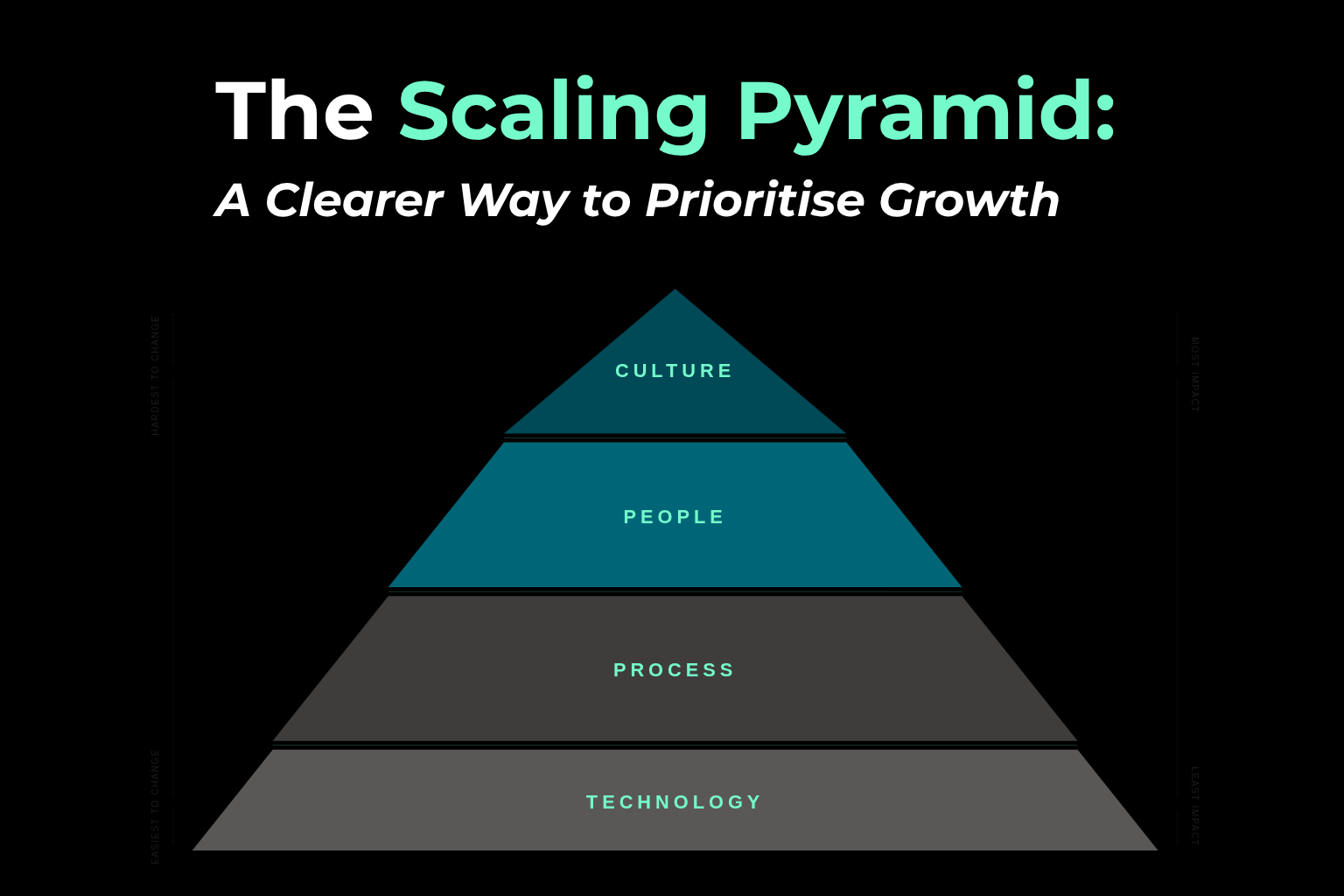
To make this tangible, Simon draws on a framework he first sketched out years ago when he was deep in the weeds of building his own businesses. Being a visual learner, he turned a complicated question – ‘what should I focus on to scale?’ – into a simple pyramid. It’s a model he has returned to again and again, across hundreds of business relationships, and it holds up every time.
The Scaling Pyramid: Four Layers, One Direction
The pyramid works on two axes simultaneously. From bottom to top, you move from easiest to implement to hardest to change. And from bottom to top, you also move from least impact to most impact. The four layers, from base to peak, are:
- Technology – The easiest layer to implement. It plays an important role in scaling, but its impact is relatively limited in isolation.
- Process – The systems and workflows built to run your technology and your teams. Good process is what turns tools into reliable output.
- People – A critical layer, and one that is much harder to change. The quality, capability, and alignment of your team underpins almost everything.
- Culture – At the top, hardest to change, and with the greatest impact. Crucially, culture is not something you bolt on, it is the product of the three layers beneath it.
This is a deceptively simple model, and that’s entirely the point. When you are in the middle of running a growing business, clarity is everything. The pyramid gives you an instant read on where to look and in what order.
It’s Almost Always a People Problem
Here is the insight that Simon leads with when he starts any new client relationship at Scaled: regardless of how a problem presents itself, his first question is always ‘where is the people problem?’
Because here is what experience teaches you: if you have a process problem, it is often a people problem. If you have a technology problem, it is usually a people problem. The symptom presents lower down the pyramid, but the root cause is almost always found one or two layers higher.
Good businesses know this intuitively, which is why they invest in leadership quality earlier than feels comfortable, bring in better people than they think they need, and constantly raise the bar on who they hire and how they develop their teams. This is not a luxury for bigger companies – it is exactly what enables businesses to break through the ceilings that stop most service firms from scaling.
What About AI and Technology?
Simon is candid about where the future might be heading. AI, in particular, has the potential to invert the pyramid entirely – a world where technology solves process and people problems from the bottom up, rather than the top down. It is a genuinely interesting challenge to the model.
But his view is clear: we are not there yet. Right now, in the real world of growing B2B service businesses, the pyramid holds. People problems create process problems. Process problems create technology problems. If you are firefighting somewhere lower in the stack, the answer is almost always to look upwards.
What This Means for Your Business
The Scaling Pyramid is the kind of framework that is most useful not as a one-off diagnostic but as a regular lens through which to view your business. A few questions worth sitting with:
- When you think about your biggest current constraint to growth, which layer of the pyramid does it appear to sit in?
- If you stripped back the symptoms, is there a people or culture issue underneath that is driving it?
- Are you hiring and developing people to the standard your next stage of growth requires – not just the stage you are at today?
These are the kinds of conversations that Scaled has with every business it works with as part of the initial discovery process. The pyramid does not give you all the answers, but it does give you the right place to start looking.
Find out which layer of the pyramid is costing you growth.
Understanding which layer is holding your business back is the starting point for everything Scaled does. If you’re ready to find out where to focus, get in touch here.