Burnout is a real risk for motivated founders, particularly when they’re building something great and it’s scaling quickly. At Scaled, we spend a lot of time with founders in the messy middle of growth: the point where the business has momentum, customers and increasing complexity – but still relies heavily on the founder to keep everything moving. It’s a powerful stage, but it’s also where endurance starts to matter as much as strategy.
Founder burnout is often talked about like a personal resilience issue. In reality, it’s frequently an operating model issue. When too much of the company runs through one person, the business quietly becomes a machine that consumes the founder’s attention, energy and emotional bandwidth.
A recent Notion study on founder endurance (referred to as their “Negative Split” research) put numbers against what many leaders already recognise. A significant portion of founders in scale-ups work 60+ hours per week consistently, and around half have experienced real burnout. That combination isn’t a quirk of ambitious people, it’s a sign that scale is outpacing structure.
Burnout Rarely Happens At The Start
In the early days, founders can run hard without feeling the cost. The work is exciting. Progress is visible. Wins come quickly enough to keep adrenaline high. Even when the hours are long, it doesn’t always register as “burnout” because the momentum is energising.
But then the tone changes.
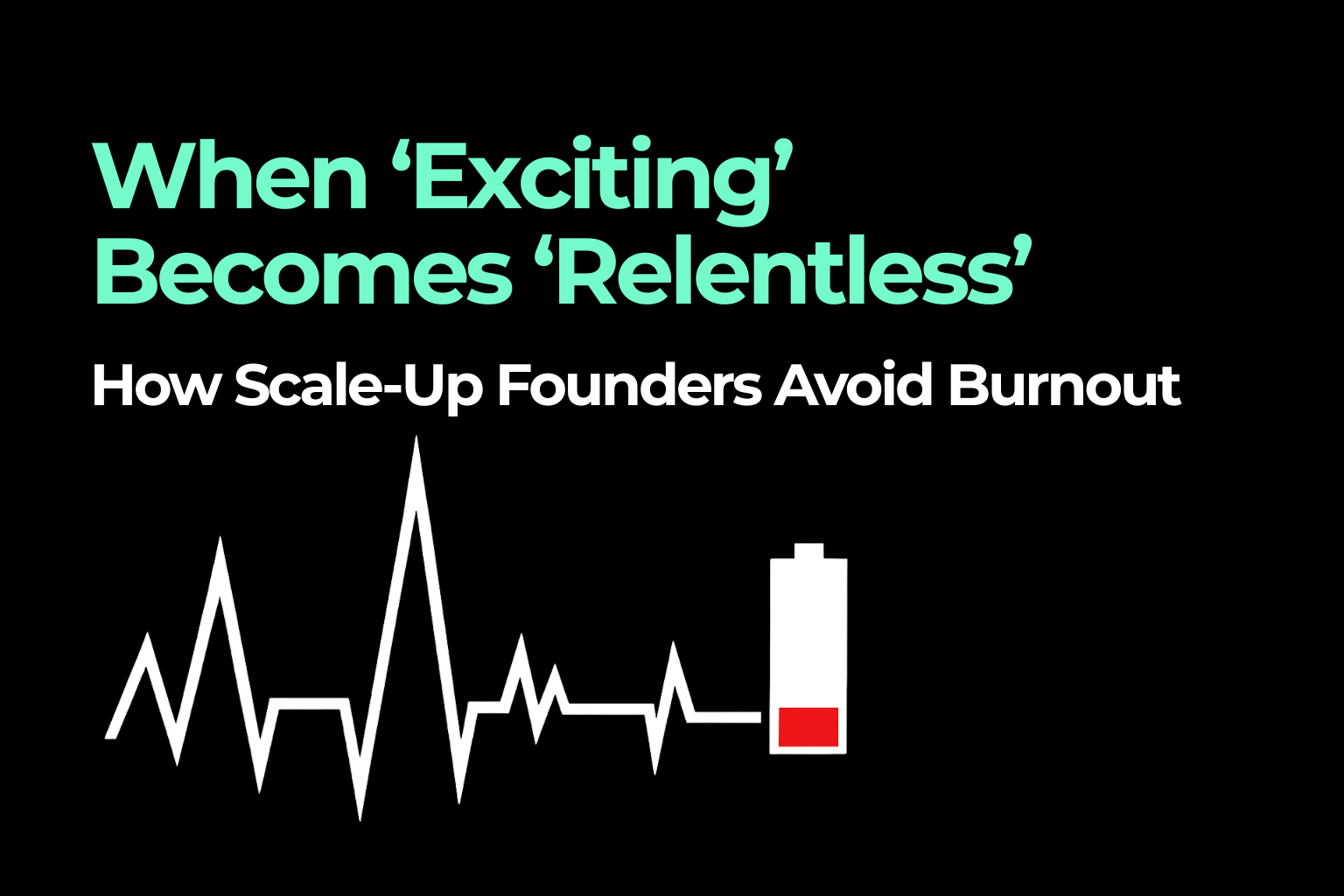
Somewhere along the way, “exciting” becomes “relentless”.
That shift is where burnout tends to show up – not at the beginning, but in the middle of the race. The company is now big enough to generate constant demand, but not yet mature enough to carry that demand without founder involvement. And because the founder has been the engine from day one, dependency often feels normal… until it becomes unsustainable.
The Root Problem Isn’t Hours. It’s Dependency.
When founders feel burnout approaching, the first instinct is often to take time off. That can help in the short term, but it doesn’t address the underlying constraint if the business still depends on the founder for every critical decision, every quality check, every client escalation and every moment of momentum.
In practice, the most useful question isn’t “How can the founder work less?”
It’s:
What needs to change so the business doesn’t depend on the founder?
That question reframes burnout as a solvable business problem, not a personal failing.
Growth Demands A Different Founder Role
Early-stage businesses reward doing. Founders ship. Sell. Deliver. Fix problems. Push through bottlenecks. They move fast because they have to.
But scale changes the job.
As complexity increases, the founder’s role has to shift from doing the work to designing the system that produces the work. That means moving from heroic effort to a durable process. From personal output to team throughput. From being the person who solves everything to being the person who ensures the business can solve things without them.
This is where many founders get stuck, not because they aren’t capable, but because the business has reinforced the pattern of founder-as-solver for years. The paradox is that the founder’s competence is often what creates the dependency.
What A Durable System Actually Requires
In Scaled’s experience, the transition away from founder dependency usually comes down to two practical shifts.
First: hiring “done it before” capability earlier than feels comfortable. Most founders wait too long to bring in leaders who can genuinely take ownership. They hire “good enough” to protect cash, or hire junior and hope to coach them up. But if the goal is to reduce dependency, the business needs people who can design the function — not just execute tasks within it.
Second: letting those people build the process, then measuring outputs properly. Strong hires fail when they’re forced to operate through the founder’s lens. The goal is not to clone the founder’s way of working. The goal is to create clear outcomes, decision rights, and accountability, then build a cadence that makes performance visible without the founder being in every meeting.
Durability comes from clarity: what good looks like, who owns it, how it’s measured, and how decisions get made.
A Simple Exercise That Surfaces The Real Work
When a founder feels that “relentless” creep in, the fastest way to make progress is to turn the stress into a structured list.
At Scaled, we often start by mapping everything that currently depends on the founder — decisions, relationships, knowledge, delivery, approvals, momentum. Once it’s visible, it can be prioritised. And once it’s prioritised, it can be tackled one domino at a time.
This is how founder endurance is built in practice: not via a dramatic “exit the day-to-day” project, but via a sequence of small structural changes that gradually remove single points of failure.
The Goal Isn’t A Lighter Diary. It’s A Stronger Company.
The healthiest scale-up founders aren’t always the ones working the fewest hours. They’re the ones whose business doesn’t wobble when they step away.
That’s the real marker of endurance: a company designed to scale without consuming the founder as the hidden cost of growth.
If this topic resonates, the starting point is straightforward:
What needs to change so the business doesn’t depend on the founder?
Answer that honestly, make it visible, prioritise the list and start knocking the dominoes down.